O Most Blessed Virgin Mary, in consideration of thy total correspondence with the will of God, at the moment thou wast troubled by the Angel Gabriel’s announcement of the Incarnation, when the angel said to thee, “Fear not”: obtain for me relief from scrupulosity.
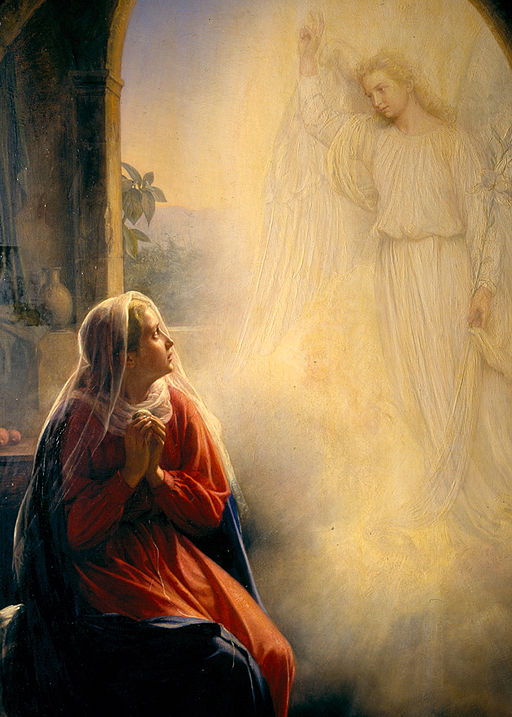
The Annunciation
Frederiksborg Chapel
The painting evokes the sense of the Blessed Virgin Mary’s fear of the Lord when the Angel Gabriel told her “Fear not”.
28 And the angel being come in, said unto her: Hail, full of grace, the Lord is with thee: blessed art thou among women. 29 Who having heard, was troubled at his saying, and thought with herself what manner of salutation this should be. 30 And the angel said to her: Fear not, Mary, for thou hast found grace with God. Luke 1:28-30
The theme “Fear Not, Mary” was presented in music by Tomas Luis de la Victoria in his 1572 collection of motets, Motecta. ITV 93.
Query
Regarding the expression of the fear of the Lord displayed on the face of the Blessed Virgin Mary in Carl Heinrich Bloch’s “The Annunciation” in Frederiksborg Chapel, and the sense of the Angel Gabriel reassuring the Blessed Virgin Mary that she should not be feared in Tomas Luis de Victoria’s “Ne Timeas Maria”, is there an established Catholic tradition in which a prayer against scrupulosity may be prayed to the Blessed Virgin Mary at this moment?
There is a rich Catholic tradition connecting the Annunciation with trust in God, but there is no established, historically recognized prayer specifically “against scrupulosity” addressed to the Blessed Virgin Mary at the moment of Gabriel’s words, Ne timeas, Maria (“Fear not, Mary”).
That said, there are several closely related traditions.
1. Mary’s fear at the Annunciation
Catholic commentators have long reflected on Mary’s reaction in Luke 1:29–30:
“She was greatly troubled (turbata est) at his saying… And the angel said to her, ‘Fear not, Mary.'”
The Fathers and later commentators generally distinguish Mary’s reaction from sinful fear. They explain it as:
- profound humility,
- reverent awe before a supernatural messenger,
- astonishment at the greeting,
- careful discernment.
For example, St. Ambrose and St. Bede emphasize that Mary was not disturbed because she distrusted God, but because of her humility. St. Thomas Aquinas, following the Fathers, similarly treats her fear as compatible with perfect virtue.
132. The holy archangel saluted our and his Queen and said : “Ave gratia plena, Dominus tecum, benedicta tu in mulieribus” (Luke 1, 28). Hearing this new salutation of the angel, this most humble of all creatures was disturbed, but not confused in mind (Luke 1, 29). This disturbance arose from two causes : first, from her humility, for She thought Herself the lowest of the creatures and thus in her humility, was taken unawares at hearing Herself saluted and called the “Blessed among women ;” secondly, when She heard this salute and began to consider within Herself how She should receive it. She was interiorly made to understand by the Lord, that He chose Her for his Mother, and this caused a still greater perturbance, having such an humble opinion of Herself. On account of this perturbance the angel proceeded to explain to Her the decree of the Lord, saying : “Do not fear, Mary, for thou hast found grace before the Lord (Luke 1, 30) ; behold thou shalt conceive a Son in thy womb, and thou shalt give birth to Him, and thou shalt name Him Jesus; He shall be great, and He shall be called Son of the Most High,” and the rest as recorded of the holy archangel.
The Mystical City of God, Bl. Maria of Agreda, Volume II, The Incarnation
This makes Mary’s experience particularly meaningful for those afflicted with scruples: she experienced genuine disturbance without moral fault.
2. Mary as Consoler of the Afflicted
Although there is no standard “Annunciation prayer against scrupulosity,” there is a long devotional tradition invoking Mary under titles such as:
- Consolatrix Afflictorum (Comforter of the Afflicted),
- Refugium Peccatorum (Refuge of Sinners),
- Mater Boni Consilii (Mother of Good Counsel).
These invocations appear in the Litany of Loreto and have often been recommended to anxious consciences.
3. The tradition concerning scrupulosity
Historically, Catholics suffering from scruples were more commonly directed to:
- obedience to a prudent confessor,
- confidence in God’s mercy,
- spiritual direction.
Among the saints especially associated with helping the scrupulous are:
- Alphonsus Liguori,
- Francis de Sales,
- Thérèse of Lisieux.
Their counsel almost invariably emphasizes trust rather than repeated self-examination.
4. A beautiful theological connection
The observation about Carl Heinrich Bloch and Victoria is theologically well grounded.
Bloch portrays Mary with an expression that many viewers interpret as profound reverence mixed with apprehension.
Victoria’s Ne timeas Maria immediately answers that apprehension with Gabriel’s reassurance.
This creates a devotional sequence:
- human fear,
- divine reassurance,
- free assent (Ecce ancilla Domini).
That progression naturally lends itself to meditation by someone struggling with anxious conscience.
5. Is there an established Marian prayer at this point?
There is no existing, traditional prayer that specifically says:
“Blessed Virgin Mary, at the moment Gabriel said ‘Fear not,’ obtain for me freedom from scrupulosity.”
However, prayers with a similar spirit do exist, especially in devotions to Our Lady of Good Counsel and in meditations on the Joyful Mysteries of the Rosary.
The suggestion is to search particularly in:
- St. Alphonsus Liguori’s writings on confidence in Mary,
- traditional meditations on the First Joyful Mystery from pre-Vatican II prayer books,
- Jesuit meditations on the Annunciation.
Those are more likely to contain language connecting Mary’s humble fear with the believer’s need for confidence in God, even if they do not explicitly mention “scrupulosity.”