This advocacy piece would merely be a paranoid, conspiratorialist rave–except that the actual evidence is all in the notes. (This posting isn’t intended so much as an article, as a set of easily accessible notes for making arguments.)
You can sometimes learn more from your presumptive ‘opponents’ than from your alleged friends, who can actually be acting in Pecksniffian self-interest, presenting viewpoints which don’t reflect their actual understanding, agendas intended to bring about certain effects over target populations not in their interests but in those of elite groups, “the better classes”. Such masked public personae can use economic leverage to advance ideologies at significant variance from truth, on the presumption that they know better than you what you need to know. Dissent from these dark movements can come from any part of the political spectrum; we can’t afford arbitrarily to exclude the viewpoints even of people with whom we mostly disagree, but we have to take what truth they possess as it comes, however partial.
Regardless of the functional debilities of extreme leftism, Noam Chomsky still aspired to the tenet of classical liberalism, that “I strongly uphold your right to your point of view, no matter how strongly I disagree with you”. It’s sometimes worth listening to what he had to say.
Noam Chomsky, citing Ralph Waldo Emerson on the elites’ rationale for agitating for universal, compulsory education: “The grounds on which eminent public servants urge the claims of popular education, is fear” … [that, in their words, he says] … “This country is filling up with thousands and millions of voters, and you must educate them to keep them from our throats”, meaning, “educate them the right way,” keep their perspectives and their understanding narrow and restricted, discourage free and independent thought, and frighten them into obedience –something that’s done over and over in the schools as well–we’ve all experienced it.”
WE breed water dogs not to bite game birds, we hood falcons to control them, when race horses run too fast we “handicap” them with lead weights, and when students are in danger of independent learning so that they threaten to evade being conditioned into mindless consumers and docile, unquestioning employees of giant corporations, we subject them to “schooling”.
College graduates today have been denied, by design, a basic liberal-arts education that was freely available to many 1-room schoolhouse, elementary students prior to the imposition of universal forced schooling in the period 1880-1920. It was a result of planned, deliberate deprecation of curricula and intense, adverse behavioral conditioning, which long preceded their high school graduation. A vast store of evidence for this assertion, unknown to the general public, is in freely available authors in a tradition of “studies of Deliberate Dumbing Down K-12”. (Author list at the end of the article.)
.
The issue of deliberate dumbing down (DDD), of unimaginably vast scope, centers on the confidential history, virtually never discussed openly in the press or taught in schools or colleges themselves, that contrasts the rigidly controlled, standard anti-intellectual conditioning children receive today in public schools, with the extreme opposite, self-directed, radical freedom which prevailed in America prior to the railroads (1840).
.
America from the Colonial/Revolutionary period, until the mid-19th century, was an outpost of personal independence, granted immunity by geographical isolation, from the restrictive model of Europe’s old-world, highly stratified class system. (America was at a colonial “margin” at some distance from the imperial center, England. The historical dissolution in the mother country of the ancient, manorial-feudal medieval society in which peasants had traditional rights to the land which their lord could not abrogate, had been disrupted centuries earlier in England than in America, with the enclosure of common lands for specialized sheep-grazing for the Italian wool trade by the lower gentry, socially rapacious behavior in common with the higher nobility, friends of Henry VIII, in the despoiling of Church lands built up over centuries of free labor accumulation under the evangelical counsel of Poverty. This pattern of dissolution only encroached on the colonial margin in America, centuries after it happened at the center, in England.) For instance, it was illegal in 19th century England to teach to lower class children, what John Taylor Gatto termed “the active literacies”, writing, public speaking and the cultivation of eloquence.
.

Concurrent with the liberal Protestant biblical studies (“Historical-Critical Method”) of Adolf von Harnack in the late 19th century which “proved” that biblical accounts of miracles were “fantasies”, agnostic or atheist northern German philosophers were instrumental in enlarging on the rationalist foundation of the French Enlightenment until the late 19th century rise of the Fabian Socialist Society (symbol: a wolf in sheep’s clothing) espoused by the high architects of compulsory, universal, dumbed-down schooling. In contrast with the 99% of humanity which has believed in some sort of God, “when people stop believing in God, they don’t believe nothing, they’ll believe anything”.
.
“There can’t be a God, nor any Heaven”, (the outlook that “proves one is a ‘scientist‘ “), therefore, let’s “create” heaven on earth, “eat, drink and be merry, for tomorrow we die”, (never to be resurrected into any eternal paradise), continually “improving” humanity, reinventing ourselves, on Darwin’s racist model of human “survival of the fittest”, leading to Hitler’s death factories and ultimately, today, to Bill Gates’ great purge of the “excess” of the majority of humanity.
.
A free people would never accept this. Therefore, starting in the mid-19th century, American children had to be wrested out of their family traditions and religions by secretly socialistic, anti-intellectual conditioning, subjecting them, in compulsory, universal, police-enforced, deliberately dumbed-down schooling, beyond the parents’ knowledge and understanding, to the endless drudgery of factory schooling, “at least keeping them off the streets and out of trouble”, precisely from the age when their brains should be furiously, delightfully absorbing everything about the wonderful, fascinating world.
.
Because solid learning from ancient times, the Trivium of Grammar (the mechanics of speech and the its application to include good literature), Logic (how, not what, to think) and Rhetoric (persuading others of the truth, and learning it yourself in greater depth in the process), protected students from exploitation by elite controllers of society, students had to be subjected to the fun-house world familiar in the school institution today.
.
This required laying the foundation for schooling, not on the basis of the classics of Western Civilization, the first among equals of nine great world civilizations–the free legacy of each citizen of the world–but upon planned disruption of them and opposition to them–the chimera of cultural appropriation as asserted by people with no appreciable education, nor even, culture, themselves–by vilification of the great and the good books (Dead White Males), and by an insidious control curriculum to thwart the acquisition of a solid academic foundation, to deliberately “crush the imagination” and stymie development of habits of independent thought immune to elite control.
.
“The language of Shakespeare and classical literature—at the least Virgil, Plutarch, Cicero, and Homer—so permeated the letters and journals of frontier Americans that modern readers have difficulty understanding that generation’s literary metaphors.” – The Myth That Americans Were Poorly Educated Before Mass Schooling
Americans of the Colonial-Revolutionary period had a literacy rate in the high 90th percentile, in the absence of European social controls, virtually all Yankees, even indentured servants and slaves, the common people, were able to learn on their own, to understand and debate the sophisticated politics of Thos. Payne’s “Common Sense” (600,000 copies sold to a population of 2.3 million Revolutionary Colonialists), the Federalist and Anti-Federalist papers at a depth incomprehensible to today’s mal-educated college students, even to Poli-Sci graduate students.
.
This accorded with the Protestant ethic that people must be able to read their Bibles. Americans typically attained solid, basic literacy in a mere 40 hours of phonics, and practical numeracy in only 42 hours of arithmetic study (my grandfather, William Penny Keevers, a grocer, could add a running 3 column total in his head without a mechanical calculator), after which 13 year olds were expected to be pursuing self-employment and could enlarge their own education with such limited resources as were available to them, largely the Bible, Shakespeare and Plutarch’s Lives–not a bad foundation.
.
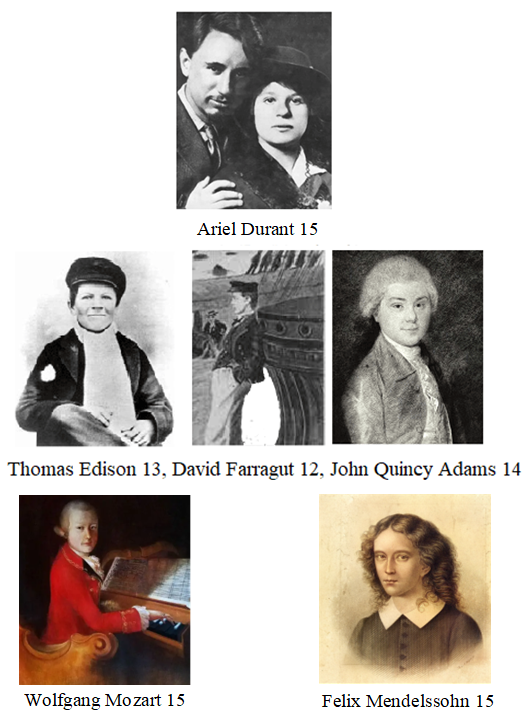
Rather than the indefinite postponement, under control by “educational” specialists, of the pursuit of an active, self-realized life, self-employment and self-reliance were the default life path expectations for young people of the early 19th century, and were closely allied with productive, basic education of the type systematically denied to young people today.
.
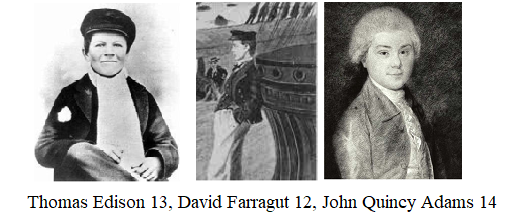
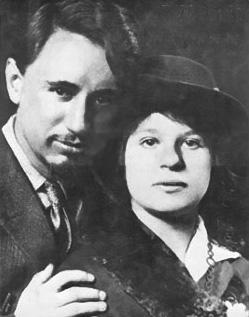
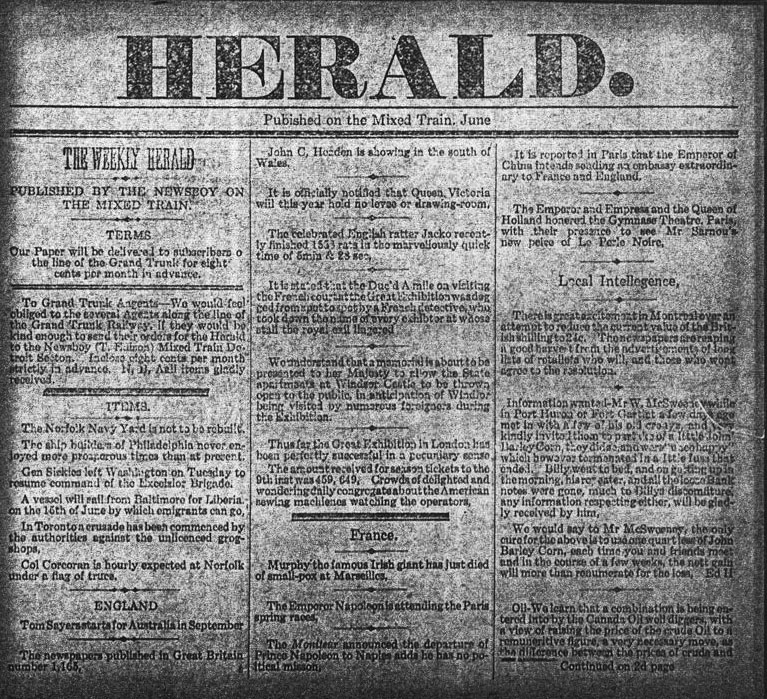 Despite elaborate anxiety about “child labor”, there are numerous anecdotes about adult-acting 13 year olds like Thos. Edison (publisher of the Grand Trunk Railroad “Herald“), David Farragut (commanded captured British prize ship with unruly prisoners at 12) and John Quincy Adams (the only member who spoke Russian in the early Revolutionary-period, U.S. diplomatic mission to the court of Saint Petersburg, active in diplomatic negotiations, at 14).
/
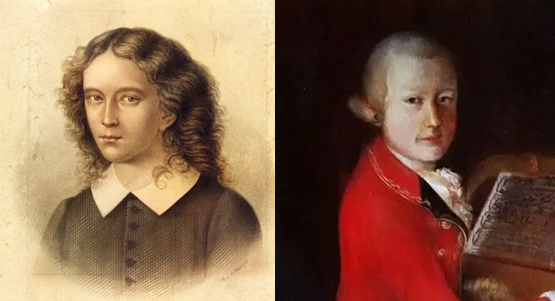
.
Allegro Molto of Felix Mendelssohn’s String Symphony No. 8 in D major, the piece written as one of a group between the ages of 12 and 14.
.
Allegro of Wolfgang Amadeus Mozart’s Divertimento in D Major K. 136 written when he was 16. (Mozart was 14 when he risked the excommunication, if not the death penalty, by transcribing Allegri’s Miserere, which was the proprietary privilege of the Papal Choir.)
.
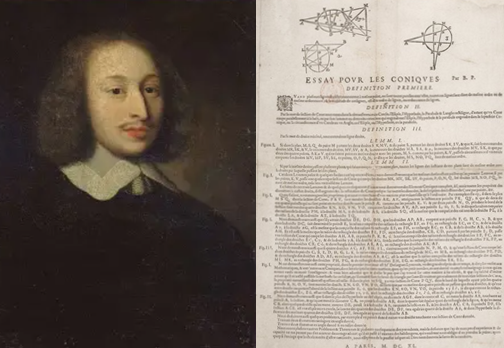
Names of today’s communities with a continuing, strong ethos of self-employment, necessarily involving the freedom of young adolescents to spread their wings unimpeded by controls from the financial ultra-elite, are the North American Amish and the Spanish Catalan/Basque Mondragon Commune.
.
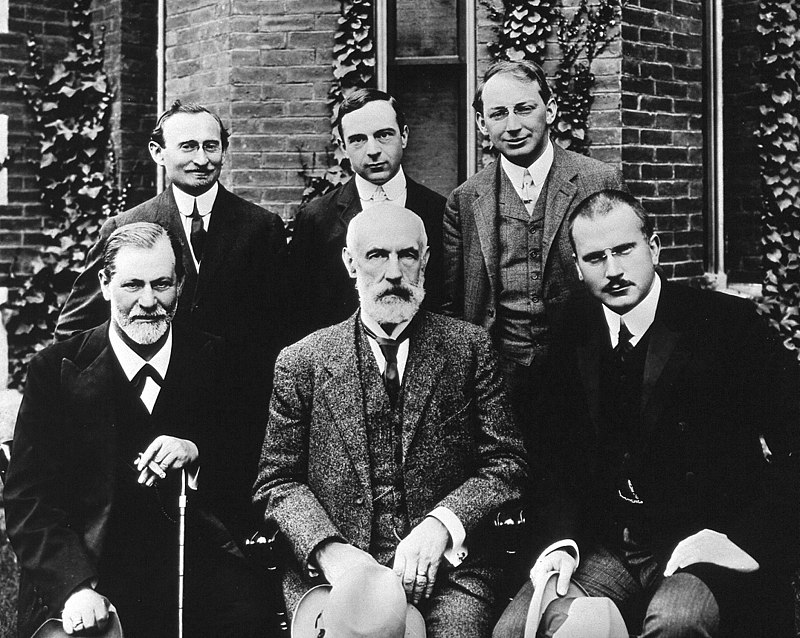
“The knowledge which illiterates acquire is probably a much larger proportion of it practical. Moreover, they escape much eyestrain and mental excitement, and, other things being equal, are probably more active and less sedentary. It is possible, despite the stigma our bepedagogued age puts upon this disability, for those who are under it not only to lead a useful, happy, virtuous life, but to be really well educated in many other ways.” – G. Stanley Hall, in praise of the virtues of illiteracy, 1911The rapid, forced industrialization of the American people from 1880-1920 required direct squelching of young people’s vigorous pursuit of their life path. Prussian-trained G. Stanley Hall applied the German-Romantic concept of sturm und drang, “storm and stress”, in his 1904 book Adolescence : its psychology and its relations to physiology, anthropology, sociology, sex, crime, religion and education to the labor-oversupply side of industrial capitalism’s chronic overproduction. Hall’s work introducing the novel category adolescence, resulted in the diversion of millions of young people away from the pursuit of a productive, self-directed livelihood, relegating them to the dead end of perpetual adolescence in deliberately dumbed down schools, a principle now to be extended indefinitely into old-age with Life-Long Learning as documented by John Klyczek.
Prior to the Civil War, when 97% of the population were engaged in the self-directed pursuit of agriculture, the ideal was self-employment on wholly-owned farms, true agrarianism—you produced everything your family consumed—without any participation in a money economy, only barter, from your own excess agricultural production, for items beyond self-production, perhaps a plow you couldn’t forge for yourself.
.
.
A researcher studied the simple work diary of a Yankee farmer from 1775-1795. If one his journal entries for a certain date was “made a barrel”, he had to have pre-cured the raw wooden staves in a curved shape, perfectly planed the curved pieces in the shape of waterproof staves, planed with water-tight fitting. Meanwhile, he had to forge the two hoops at either end, but their shape would have to be slightly flared with a curve. Then he fit the wooden ends, and made a bung-hole and a wooden tap. In an industrial economy, he would be considered a journeyman. But on the farm where “you did everything”, this task that would have given him the name “cooper” was only one of 200 “vocations” which he was qualified to practice. His sons would have trained with him, on the expectation that they would become self-employed on farms they wholly owned; they would not be confined to a soul-prison with rootless kids of their own age who couldn’t tell each other who they were, they would be sure of their identities. But instead, their great-great-great grandsons, having been dispossessed of their inheritance at the close of the Civil War by the tax-man and Wall St., the common class forced into industrial work, would have the “life vocation” of turning a single nut on Mr. Ford’s assembly line, every 8 seconds for 14-16 hours per day, six days per week, no vacations.
We want one class of persons to have a liberal education, and we want another class of persons, a very much larger class, of necessity, in every society, to forego the privileges of a liberal education and fit themselves to perform specific difficult manual tasks.…we are trying to make skillful servants of society along mechanical lines… (Woodrow Wilson, High School Teachers Association of New York, Volume 3, 1908-1909)
Mr. Gatto related how by 1880, after the railroad facilitated carnage of the Civil War, Americans were being forcably moved off their own farms — where they did everything — and into millionaire owned factories, where they were just cogs in a machine. (Financial exploitation of indebted soldiers returning from the Civil Was is one common explanation for the forced exodus.) The titans of Wall St., Morgan, Carnegie, Astor, Vanderbilt and Rockefeller, regarded the Yankee tradition of auto-didactic, small farmers, mechanics/engineers, inventors and entrepreneurs, as a lethal competition threat to Financial Capitalists’ Wall St. accumulation of investment monies. The elites’ most efficient solution was to undermine this threat by strangling it in the cradle; the effort to control, at the dawn of the information age, the intellectual uprising of the common people coalesced in the very foundation of universal, compulsory/police-enforced public schooling. The compulsory, universal public school system as we understand it, was never without built-in institutional handicapping of the vast majority of students.
“In our dreams, we have limitless resources, and the people yield themselves with perfect facility to our molding hands. We shall not try to make these people or any of their children into philosophers or men of learning or men of science. We are not to raise up from among them authors, educators, poets, or men of letters. We shall not search for embryo great artists, painters, musicians, nor lawyers, doctors, preachers, politicians, statesmen of whom we have ample supply. The task we set before ourselves is very simple. We will organize children and teach them to do in a perfect way [, under dehumanizing, factory-centralized, scientific planning,] the things their fathers and mothers are doing in an imperfect way.” – Archives of the Rockefeller-funded General Education Board, credited with setting up American primary educational curricula from 1903 onward. https://www.youtube.com/watch?v=ntM8Dig2Ryo
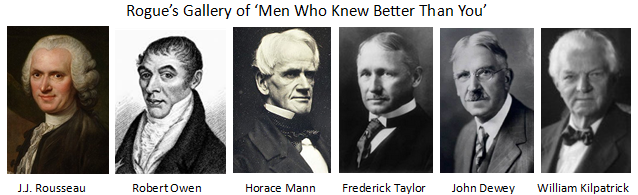
This calculated, intellectual poisoning was formally predicated on the writings of a Prussian philosopher, Johann Fichte who had written “Addresses to the German Nation” (1808-1818) dedicated to the King of Prussia, demanding compulsory, universal schooling–which in its implementation had the effect of deliberately dumbing-down the populace, laying fault for the Prussian defeat by the French in the 1806 Battle of Jena to decadence, selfishness, and lack of patriotism, with the implication that the French model was too external and superficial. Napoleon held the motto “every corporal with a field marshal’s baton in his rucksack”–implicitly, that non-commissioned, non-professional infantry were formally directed to countermand orders from the elite, stratified professional officer class when local battlefield situations dynamically change. “The French let their commoners loose with too much independence, that’s why we lost to them” is how the Germans received Fichte’s observations. Failed Indiana New Harmony commune leader Robert Owen proposed deliberate dumbing down to the Prussian king around 1830.
.
Mr. Gatto charmingly terms the gist, “we have to crush children’s imagination”, to stop lower class people from running amok threatening destabilizing, inventive innovation, disrupting the carefully regulated, top-planned economy, by regimenting all children into universal, compulsory, Deliberately Dumbed-Down (DDD) schooling.
.
The forces which propagated this system nearly 150 years ago, have become in our time, resolutely self-perpetuating for no advantage to the greater commonweal. The system’s original, in its time, perhaps somewhat legitimate purpose, was to supply labor demand during a period of rapid industrial expansion greater than a century past. Now that our jobs and factories have been shipped overseas, starting during the Reagan era, there is no longer any reason to continue top-down directed, deliberate-dumbing down policies, originally intended to stymie self-actualization and autonomy in young people’s life course, self-determination. But the proprietors have become an institutionalized force dedicated arbitrarily to making permanent, their own, now-obsolete role, despite the obvious harm to the majority of young people.
.
The curriculum of the early K-12 grades in the Prussian system would be recognizable today from the current iteration of deliberate dumbing-down, Social-Emotional Learning: pastels, crayons and balloons. But at the age of 13, students were set to fighting one another, also recognizable in the adverse social conditions formally fostered in the schools (Bianca, You Animal, Shut Up!). One in 200 students would be the high leader, recognizable as the Alpha in Aldous Huxley’s Brave New World outline of Alphas-Epsilons. The top 6 students tasked with implementing the Alpha’s directions would correspond with the Beta, administrator class. The middle Gamma-Delta classes, the vast majority, would be taught to fear and envy the top classes, and despise the “dumb kids”, implicitly, the Epsilons.
.
However, investment advisor Alex Krainer, whose portfolio ran at 26% profit during the 2008 mortgage investment, real-estate meltdown, notes not only the imminent disappearance of the blue-collar Deltas, the “sweating classes”, but the serious contraction due to A.I. of the very Alphas, the Professional-Managerial administrative class, who, at 25% of the population, only need to supply 5% of such positions, the other 20% obviated by A.I., a contraction of some 80%.
.
The rise and proliferation of the Prussian-model, dumbed-down schooling system produced generations of Germans who wouldn’t cause trouble when confined to the factory floor or conscripted into the military. The revamped Prussian social-economy eventually succeeded in beating the French, in 1870. Germany’s greater success than Britain in implementing this labor model culminated in World War I, when Churchill and Lord Gray decided that the economy of previously pro-British Germany, was too great a threat to Britain’s.
.
Germany was the incubator of behavioral psychology for control of the masses, that taught that human beings were merely stimulus-responsive animals, a system that was spread in the late 19th century by German-trained, major university, psychology department chairmen to all major world countries, even China and Japan. (Paolo Lioni, “The Leipzig Connection”, free PDF.)
.
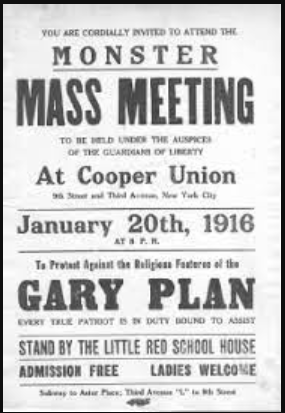
Horace Mann had 3 years to try deliberate dumbing down on the children of Boston in the 1840s, with whole-word/look-say vs phonics, but a general uproar ensued when literacy rates went down and it was temporarily halted. Dumbed-down early primary literacy conditioning went to Washington D.C. and NY; from 1880-1920 it became the law under sponsorship of the Titans of Wall St., with police enforcement. In 1917 there were riots in New York City against the 1907 Gary Indiana-model school curriculum.
.
.
What follows is a prime example of backfiring of the Machiavellian manipulations on the part of a witless elite which only have the advantage of tyrannical control, but are otherwise, completely unqualified to rule, the opposite of Plato’s Philosopher Kings–it is called “blowback” in secret intelligence/Psy-Ops, in philosophy it is called “the cunning of reason”, Die List der Vernunft of Hegel.
.
THE THIRD ROCKEFELLER GENERATION WERE INTELLECTUAL CRIPPLES: The Worm Eateth Its Own Tail (Ouroboros), The Rich Eat Their Own: Fabian Society founding member John Dewey (icon: yellow flag, black wolf dressed in white sheepskin climbing a flagpole, maroon flag with black letters “F.S.” for Fabian Society) was funded for his experimental Lincoln School by John D. Rockefeller II. The Lincoln School was attended by Rockefeller’s 4 younger sons Nelson, Laurance, David and Winthrop, some of the most powerful men in history who regulated the fates of millions of people.
.
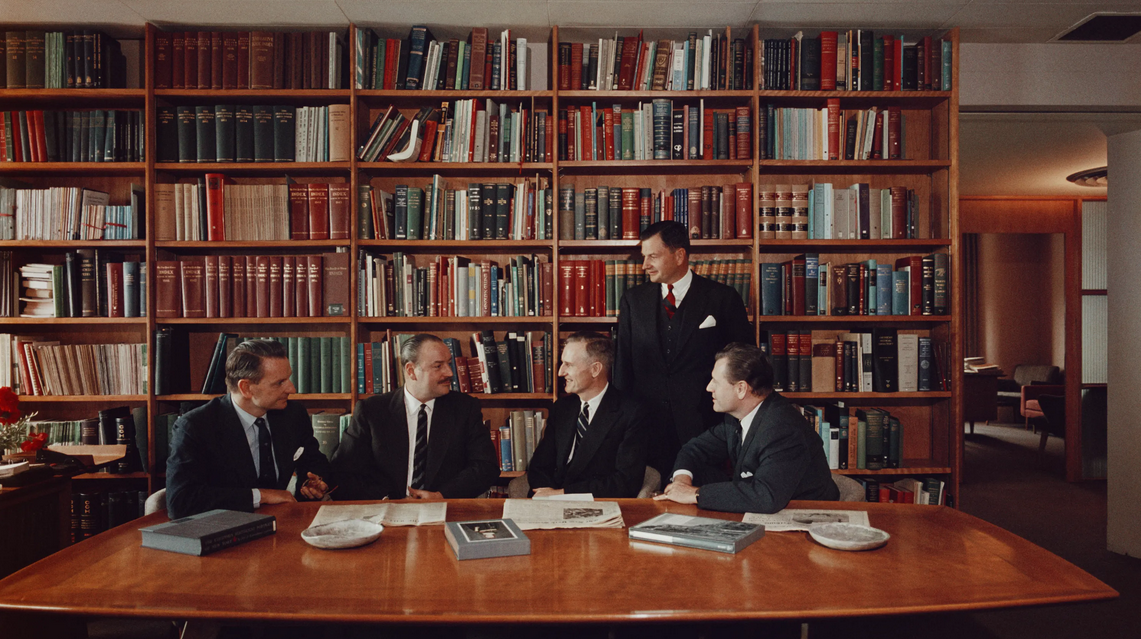
With only the exception of the eldest son J.D. Rockefeller III, all four of the other Rockefeller third generation sons emerged from John Dewey’s “whole-word/look-say” Lincoln School as intellectual cripples unable to read a newspaper: they all had dyslexia. Dyslexia expert Dr. Samuel Orton informed university psychology department “educationalists” in 1928 that increased use of the whole-word/look-see method to the exclusion of phonics is correlated with declining reading acquisition in early primary grades.
.
.
From the Internet Archive
.
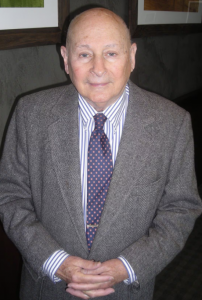
1926-2015
One of the great ironies of the Progressive Education Movement is that its leaders were able to convince John D. Rockefeller, Jr. that he ought to give his sons a good progressive education and donate $3 million to the Lincoln School, a new experiment in social education in accordance with John Dewey’s radical new ideas. So he put Nelson, Laurence, Winthrop, and David in the school, which turned them all into dyslexics, proving that progressive reading programs can cause dyslexia.
.
According to Education Encyclopedia, StateUniversity.com:
The Lincoln School (1917–1940) of Teachers College, Columbia University, was a university laboratory school set up to test and develop and ultimately to promulgate nationwide curriculum materials reflecting the most progressive teaching methods and ideas of the time. Originally located at 646 Park Avenue in New York, one of the most expensive pieces of real estate in the city, the Lincoln School was also a training ground for New York City’s elite, including the sons of John D. Rockefeller, Jr., who provided the funding for the school. Among the school’s chief architects were Charles W. Eliot, a former president of Harvard University and an influential member of the New England Association of Colleges and Secondary Schools; his protégé Abraham Flexner, a member of the controversial Rockefeller philanthropy, the General Education Board; Otis W. Caldwell, a professor of science education at Teachers College and the school’s first director; and the dean of Teachers College, James E. Russell.
Unfortunately, Rockefeller’s four sons were some of the earliest victims of school-induced dyslexia, a condition they had to deal with for the rest of their lives.
.
Jules Abel, in his 1965 book, The Rockefeller Billions, wrote:
The influence of the Lincoln School, which, as a progressive school, encouraged students to explore their own interests and taught them to live in society has been a dominant one in their lives. … Yet Lawrence gives startling confirmation as to “Why Johnny Can’t Read.” He says that the Lincoln School did not teach him to read and write as he wishes he now could. Nelson, today, admits that reading for him is a “slow and tortuous process” that he does not enjoy doing but compels himself to do it. This is significant evidence in the debate that has raged about modern educational techniques.
David Rockefeller writes of his experience at the Lincoln School in his Memoirs, published in 2002:
It was Lincoln’s experimental curriculum and method of instruction that distinguished it from all other New York schools of the time. Father was an ardent and generous supporter of John Dewey’s educational methods and school reform efforts. … Teacher’s College of Columbia University operated Lincoln, with considerable financial assistance in the early years from the General Education Board, as an experimental school designed to put Dewey’s philosophy into practice.
Dewey’s educational methods were conceived and calculated to dumb down the nation, and he started out by dumbing down the four Rockefeller boys. Nelson, of course, was in later years able to hire Henry Kissinger to do his reading for him.
.
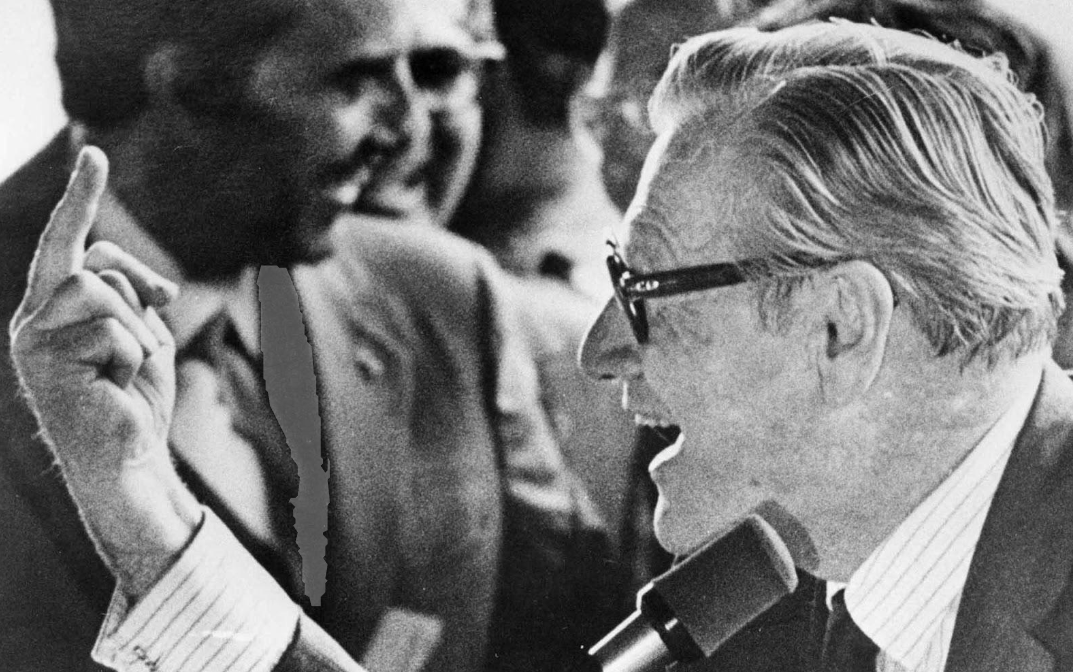
In 1976, Vice President Nelson Rockefeller famously gave the middle finger to hecklers during a campaign event, a gesture that became known as “The Rockefeller Salute.”
David Rockefeller writes further:
Lincoln stressed freedom for children to learn and to play an active role in their own education. … But there were some drawbacks. In my case, I had trouble with reading and spelling, which my teachers, drawing upon “progressive” educational theory, did not consider significant. They believed I was simply a slow reader and that I would develop at my own pace. In reality I have dyslexia, which was never diagnosed, and I never received remedial attention. As a result my reading ability, as well as my proficiency in spelling, improved only marginally as I grew older. All my siblings, except Babs and John, had dyslexia to a degree.
Apparently, David Rockefeller still doesn’t understand that he was made dyslexic by the teaching methods at the Lincoln School. He says, “I have dyslexia,” as if he were born with it, and that is why he had such a difficult time learning to read.
.
The reason why David’s older brother, John D. Rockefeller III, did not become dyslexic is because he attended the traditional Browning School in New York and the Loomis Institute in Windsor, Connecticut. He then went on to Princeton, where he received high honors in economics.
.
Winthrop Rockefeller, born in 1912, attended the Lincoln School. He later found formal education difficult, suffering from dyslexia. He entered Yale in 1931 but was expelled in 1934 for misbehavior. He had a successful military career, after which he moved to Arkansas and became its first Republican Governor. What is most significant in all this is that the experience of the four Rockefeller boys provides confirmation that the sight method of teaching reading, used at the Lincoln School, caused dyslexia. Of course, we were not able to know this until years later when their memoirs and biographies were published.
.
Yet, the progressive educators were well aware of this harmful phenomenon as early as February 1929, when Dr. Samuel T. Orton — a neuropathologist who had made a survey in the 1920s of children with reading problems in Iowa, where the sight method was being used — wrote an article for the Journal of Educational Psychology. Its title was quite explicit: “The ‘Sight Reading’ Method of Teaching Reading as a Source of Reading Disability.” He wrote, as diplomatically as possible:
I wish to emphasize at the beginning that the strictures which I have to offer here do not apply to the use of the sight method of teaching reading as a whole but only to its effects on a restricted group of children for whom, as I think we can show, this technique is not only not adapted but often proves an actual obstacle to reading progress, and moreover I believe that this group is one of considerable educational importance both because of its size and because here faulty teaching methods may not only prevent the acquisition of academic education by children of average capacity but may also give rise to far reaching damage to their emotional life.
Orton’s article was written for the very educators who were in the process of launching their sight-reading programs in all the public schools of America. And of course they rejected his warning. But it wasn’t until 1955 that American parents became aware of what was being done to their children in the schools. It was that year in which Rudolf Flesch’s famous book, Why Johnny Can’t Read, was published, and it created quite a storm among educators and parents. The educators rejected Flesch’s assertion that it was the sight or look-say method that was causing the problem, but parents read the book and many started to teach their children to read with phonics at home.
.
My own book on the reading problem, The New Illiterates, was published in 1973, some 18 years after Why Johnny Can’t Read. Indeed, in 1973 Johnny still couldn’t read! In The New Illiterates I revealed that the sight method had been invented by the Rev. Thomas Gallaudet, the teacher of the deaf and dumb at his asylum in Hartford, Connecticut, as a means of teaching the deaf both language and reading. He thought the method could also be used to teach normal children to read. So he wrote The Mother’s Primer, which was published in 1836 and adopted by the Boston primary schools as a new, easier way to teach reading. Instead, it produced a literacy disaster. In 1844, the Boston School Masters wrote a devastating critique of this new way of teaching reading. The schools then quickly went back to the phonetic method.
.
In my book, I also did a line-by-line analysis of the Dick and Jane reading program and came to the conclusion that anyone taught to read by this method could become dyslexic. But nothing I’ve written on the subject has had the slightest influence on the professors in America’s colleges of education or changed the prevailing sight methods of teaching reading in the public schools.
.
And that is why I then developed the Alpha-Phonics reading program, so that parents could easily teach their children to read at home in the proper phonetic manner. Since its first publication in 1983, thousands of homeschooling parents have used the program to teach their children to read. Of course, I have tried to get the public schools to adopt the program, but with no success. However, one high school teacher in Florida, who heard about my work and has actually used Alpha-Phonics to help potential dropouts learn to read, claims that it works miracles. He wrote in a letter to me:
I once was explaining to a student why children have reading problems. When I finished, a girl from the other side of the class, who I thought was not listening, said, “This is what happened to my brother. He is in the fourth grade, hates to read and gets stomach aches and headaches.” I told her that his troubles were over and gave her a copy of Alpha-Phonics. Four months later, I asked how was her brother doing. She said he completed the book and reads just fine.
.
I had the same success with students in special education, who were labeled as learning disabled or educatably mentally retarded. I have 100% success with every student. The only variable is the speed at which students progress. You must follow Dr. Blumenfeld’s advice and be patient. Do not pressure the child.
.
I have many other heartbreaking stories about children who have quit school because they did not know how to read, and no one will teach them. I have had children take a copy of Alpha-Phonics and keep it to teach friends they know, how to read. I encouraged everyone to try Alpha-Phonics. The results you see in the child are truly miraculous. It must be seen to be believed.
So if America wants to reclaim its preeminence as the most literate nation on earth, they can do so by simply using Alpha-Phonics in all the schools across the country. Not very difficult to do, and not at all expensive. In other words, we don’t need No Child Left Behind or Race to the Top to pretend that we are helping the kids. But a dysfunctional federal government is simply incapable of doing what can be done easily and cheaply. There is neither the will, nor the intelligence, nor the open-mindedness to make it happen. And so if you, a parent, want true education reform, you can have it instantly — at home.
.
.
Can the Humanities Be Saved?
.
A conversation with Jennifer Frey and Anastasia Berg
“The tragedy of the contemporary academy,” wrote Jennifer Frey in a New York Times op-ed this July, “is that even when traditional liberal learning clearly wins with students and donors, it loses with those in power.” Frey, a philosophy professor and former dean of the University of Tulsa’s Honors College, was speaking from direct experience: though she had built up a vibrant classical liberal arts college at Tulsa, with surging student enrollment and robust philanthropic support, the university administration decided to “go in a different direction,” discontinuing the college’s signature small-seminar class format and eliminating critical staff positions (including hers).
.
On September 29th, Frey joined Anastasia Berg, Point editor and UC Irvine philosophy professor, to discuss the hostilities and challenges liberal education faces today. What is it that we’re seeking to defend by means of humanistic study? And in an age of decreasing literacy and the rapid creep of artificial intelligence into education, can this fight be anything but a losing battle?
.
Anastasia Berg: I want to start by trying to understand how we got to inhabit the educational-institutional situation that we do now. When we say “the humanities” today, in the American context, we’re referring, however obliquely, to two things. First, to a set of specific specialized disciplines—English literature and languages, philosophy and classics, sometimes history. But at the same time, what also refer by the “humanities” or “liberal arts” to something a little murkier—it’s that something that makes the American college experience unique compared to, say, European models of higher education. In addition to their major or concentration requirements, American college students must meet an independent set of requirements in other fields. This takes the form of anything from the University of Chicago’s Common Core to the general-education requirements of the large public universities. Jen, could you tell us a little bit about how we got to this place, and how you see the relationship between these two different things we’re talking about when we say “liberal arts” or “humanities”?
.
Jennifer Frey: I could talk all night about the history of higher education in the U.S, but I’ll just give you a really quick-and-dirty version of what happened. In the late seventeenth century, you started to have institutions of higher education in the United States, and they were all small private liberal arts colleges. All these institutions were very intentionally established to be about what the Germans would call Bildung, or what the Greeks would call paideia—they were about the formation of leaders. The course of study was “liberal” in the sense that it wasn’t for the sake of some specific trade or line of work, but it was really about forming you into a free person and citizen. Non-accidentally, in these institutions, the capstone senior courses, which were taught by the university president, were in moral philosophy or moral theology. And the course of study was entirely prescribed: learning classic languages—your Greek and Latin, obviously—as well as classic literature, history, philosophy.
.
There is a sea change in higher education in the nineteenth century. To make a long and complicated story short, the federal government gets involved with land-grant universities. But the more fundamental change is that we decided that we needed to be like the Germans, taking the German research university as a model. And from there things start to switch: the lecture becomes the primary modality of learning—so you sit quietly and listen to your professor profess about specialized disciplinary knowledge. Knowledge becomes the thing that the university is about, rather than character formation, which had been the goal of liberal education. Around the same time, knowledge gets balkanized into specialized departments while general education becomes mostly elective. This started with Harvard——and everybody wants to be like Harvard, so it just kind of proliferated from there. The idea was that the students’ passions and interests should be determinative, and you just study what you want, whatever floats your boat.
.
By the time you get to the twentieth century, you have things like the Higher Education Act of 1965, where the state really gets involved in higher education. And you also have an academic landscape in which hyper-specialization becomes the norm. If you look at what happens to general education—undergraduate education outside of disciplinary knowledge—instruction gets, by and large, transferred over to graduate students, to nontenured professors or adjuncts a variety of kinds. For universities in particular, it’s an afterthought. After all, what’s really going to move you up in the rankings and the Carnegie system? It’s research dollars, research outputs. How are professors hired or fired? It’s based on their knowledge productivity—this is how the idea of the “knowledge worker” and “knowledge economy” emerges. This is the thing that really interests me as a philosopher: that the gold standard, the epistemic norm is expertise; it’s no longer wisdom or something broader that everyone is thought to need. The university becomes balkanized into completely siloed forms of expertise. If you’re an academic, that’s the university in which you live and move and make your make your living.
.
And, as a philosopher, I think that that situation hasn’t been great for philosophy. It’s unclear why more than a very small minority will need expertise in metaphysics or the things that philosophers work on. Only about 7 percent of incoming freshmen at Harvard will report planning to major in any humanities, any single one of them.1 How can that be? Well, I think a lot of it obviously comes down to the fact that we are told that education is for work. If education is for career, philosophy looks like a bad bet. (Actually, empirically, it’s not that bad, but prima facie, it looks like a bad bet.) And so when higher education is no longer, in any meaningful sense, liberal, it’s not the sort of education that everyone needs to be a free person and citizen. It’s reduced to a credential that you need, or a set of skills that you need to get a high-paying job.
.
It’s really no surprise that the humanities are suffering in that context. I believe that they will continue to suffer until that sort of status quo is disrupted somehow. So, if I had to put a thesis on the table for us to discuss it would be that the crisis of the humanities cannot be solved until general education is fixed, and general education should be unapologetically liberal in the strong sense of an education that befits a free person and citizen. We can talk about what that sort of education might entail, but I think we need to go back to the origins of that way of speaking—that there was a difference between a liberal and a servile education. And what marked off a liberal education was that it’s an education that is not yoked to some specific trade or line of work but just makes you free.
.
Anastasia Berg: How much of that old model of liberal arts should we aim to preserve? And how much of it can we realistically preserve today?
.
Jennifer Frey: That’s a hard question to answer, but let me just say this. When we think about general education, it’s what we think everyone in an institution of higher education needs to study. Whatever it is that we come up with there, we need to be asking: What is it that is going to make them wise? “Higher” education shouldn’t be higher just in its cost or in years—like it’s your thirteenth or fourteenth year of school. No, we should be thinking in terms of your highest aspirations as a human person. And to me that means that you need to be searching for something more than expertise; you need to be searching for wisdom.
.
Why do you need to be searching for that? Well, because you have to live when you graduate, right? You have to make choices. You have to be a person. And it turns out that systematic, serious reflection on what it means to be a human person and a citizen, and to live right as a tiny thing in the vast cosmos, is something that you need to have a real grip on. I have my own very particular ideas about what course of study might help you with that, but I think, just as a framing mechanism, we need to be thinking in that way about higher education. And we are absolutely not thinking in that way.
.
I can tell you how most universities are thinking when it comes to general education. Every balkanized department is just thinking how they can benefit from whatever the system is. Nobody’s actually thinking about the student, because nobody’s incentivized to think about the student. And, quite frankly, nobody even really knows how to think about the student. The student is just an abstract unit. When we think about general education, we need to be thinking about the student. And what is it that we actually think the student needs to know? I would suggest the student doesn’t need to know how to do scholarship in any of these fields; they don’t need to know how to publish or be up on the latest literature or analytic methods or whatever. They need to know how to think and reflect and communicate in a serious and disciplined way. They need to know how to write—not merely as a skill, although there is a skill and a craft there, but as a way of expressing how they have learned to think about things that actually matter to them as human beings and citizens.
.
Anastasia Berg: Your interest in the “humanities” is in them as the foundation for liberal education. Do you think that disciplinary expertise in the humanities has any role to play in general education, vis-a-vis that special liberal education? Or do you think that the condition of successful liberal education requires rethinking the idea of disciplinary expertise in the humanities altogether?
Jennifer Frey: I don’t want to completely get rid of disciplinary expertise. I just want to put it in its place. It’s just a fact that the emphasis on disciplinary expertise has been bad for the humanities—we just have real data on this. Most papers in the humanities are read by literally no one, they’re cited by no one. So whatever new knowledge you’re producing, it’s not really making a dent in anything. And, look, it’s still knowledge—it’s good in itself; I don’t deny that. But we need to understand ourselves as teachers, not only as experts. Because if you’re the expert in the room, then really, most questions should just be settled by you. As in, if you want to know what Aristotle said, ask me—I’m the expert, right?
That’s a terrible model for the humanities. What our students need isn’t an expert who can just convey information—frankly, we’re entering a world where artificial intelligence can probably do that pretty well if you just want information-delivery services. What we really need is a space where we are actually forming students, and that means a space where they can enter into a conversation that is much bigger than themselves—that they learn how to enter that conversation in a deep and serious way, that they learn habits of thinking and reflecting with other people. These are not merely intellectual habits; they’re actually moral habits that are required for conversation about difficult, contested topics to go well.
So it’s not the university’s job to tell you how to live, but it is the professor’s unique privilege to help you figure out who you are and how you ought to live in a serious way. The reason that I became me is because I did have professors who helped me enter that kind of great conversation. And we really need most professors to be able to help their students do precisely that. But we’re not trained to do that. We don’t seem to care about it. In fact, we think it sort of reeks of charlatanism or demagoguery, and I think that’s really to our discredit.
Anastasia Berg: I heard you say recently that the contemporary university is the place where authentic liberal education is least likely to thrive. We’ve been talking tonight about all these oughts and shoulds with regard to the university, but why do we insist that the university is where we should be fighting for authentic liberal education in the first place? Do you think it can be revived within universities? What would it take for that to happen? And if, as your own experience at Tulsa might suggest, the university is no longer reliably the place for that authentic liberal education anymore, can it take place anywhere else?
Jennifer Frey: These days if I’m in a hopeful mood, I’m like, Yes, of course! All we need are the right administrators and we can do this. All we need is to show that it works. But of course I did that and it was still a disaster. So, I’m a bit chastened by reality.
At the same time, for me personally, I came to the university when I was eighteen, and it just changed my life. It changed me. It changed the imaginative possibilities that I had for myself, and I just want that for other people. I came to the university a very smart idiot, and I received a real education.
I just want to call universities back to their purpose. I think it would be enormously devastating if we gave up on them. I’ve spent my entire adult life in these institutions, and in some deep sense, I love the university. It doesn’t always love me back, but I love the university, and so I’m going to keep fighting. Having said that, of course, liberal education existed before universities, and it will exist after universities, and it will exist because it addresses a fundamental human need. But it would be a crime if our universities just walked away from it entirely. So I hope that they won’t.
Attendee: Is what’s happening right now in education the continuation of something that’s been going on for the past century—e.g., specialization, and the move away from shared knowledge—or has something meaningfully changed in the past five, ten, fifteen, twenty, thirty years?
Jennifer Frey: What I’m inclined to say is that in 2008, a certain kind of rot that had been there was finally exposed. During the Great Recession our universities were publicly defunded, and also just suffered from the general financial collapse, and what we saw in response to that was that universities needed to make decisions about what they really valued—and it was never the humanities. It has continued since then. Every budget decision really reflects a value judgment. So why is it that the humanities aren’t valued? I believe that’s because universities are no longer committed to liberal education in any meaningful sense, and until they recommit it will continue to be the case.
The people who have the most power in the university need to reflect more deeply on the ways they are responsible for the fact that no one studies classics anymore. You can’t say to someone, especially in a discipline that’s quite difficult such as classics, “Well, we’ve in no way communicated your value to anyone. We’ve in no way meaningfully supported you, and now you don’t have students, so we’re going to cut you off.” I think that is exactly the way that it looks. This is all part of a continuous trend, but a lot of chickens are coming home to roost now.
Attendee: I’m wondering if there could be very large benefits accrued to expanding liberal education to teach kids, you know, that are younger than undergrads. I have two kids that are college age and high school age. And when they hit high school, in civics class, they’re reading the Bill of Rights. But so much of the context gets lost. I’m thinking, this is a very radical thing; before you even talk about the Bill of Rights or how our government is structured, you have to ask, well, what is government?
Jennifer Frey: One of my side projects in life has been getting involved in the K-12 classical education space. I think a lot of the problems in higher ed are inherited from K-12. Depending on what sort of institution of higher education you’re in, you’ll see different aspects of that problem, but the status quo of K-12 education is not worth defending in any way, shape or form, and needs to be fundamentally reassessed. But until we manage that, we are dealing with the products of that system that we inherit. And this is why I like to go back to the claim that I was a very smart idiot when I entered university. I had been in gifted and talented classes since first grade, and I did all AP, yada yada yada—and I knew almost nothing interesting, honestly. Once I started to see how vast the space of what I didn’t know—and didn’t even know I should know—was, at first I was kind of horrified, but then I was like, “Oh my gosh. I really want to know all this stuff.” In high school I never had someone so much as pose any kind of philosophical question to me. It never happened. It’s just not the way we were taught.
Attendee: I’m a scientist, but with two daughters who are deeply involved in humanities. And just as you said, Jen, my whole life changed in university because of my exposure to a real liberal arts education. I’ve been a professor and my colleagues sometimes leave the sciences out of a discussion of liberal arts and of general education, which I find really sad, because it is a different way of knowing. So I’d love to know how you perceive the sciences and their role in general education.
Jennifer Frey: One of the joys of starting a new college and really working on curriculum was sitting down with professors, and the professors who were into it were really into it. A fair number of them were what I would call people in STEM. We would sit down once a week for an entire semester, and we would talk about what a liberal education in science would look like.
I was trying to grow this Honors College, and I was like, “Hey, we have this great books core, it’s amazing.” But I also felt that we needed to have honors classes, really, in every college, and those classes need to be liberal. I had the most amazing conversations with physicists, with biologists, with mathematicians, about how to do that. What we shared in common across disciplines was not just learning a technique, but the importance of asking fundamental questions about our chosen disciplines. The scientists had all reflected on these fundamental questions and really wanted to do that with students, but were never given an opportunity to. So, for example, in biology: What is life like? What actually is life? Which is a difficult question. Once you start thinking about it, it’s not so clear what life is. And then, similarly, in physics, physics shades into metaphysics really quickly. They were also very interested in studying the classical texts of their field. Biologists really wanted to study Darwin with their students and finding a way to integrate it into a biology class. So I don’t think there’s any one way to do it, but I think it’s about turning the class into a form of knowledge for its own sake, with deep, serious reflection on what the discipline is and more foundational questions.
Attendee: I’m the associate director of the humanities center at my university, and I am proud to say I’m a part of a department that still puts students first. We are struggling with big questions about the role of education. I completely agree that it is to help our students think and write and be able to make good choices in life after they finish a university education. But we are being squeezed constantly because of the low enrollments. And I’m wondering if you can offer any practical solutions about how to convince administrators, deans, the provost, of the value of humanities education. The people in administration seem to acknowledge that there is intrinsic value in the humanities, but when it comes to the curriculum and support for the humanities, it’s not there because our numbers are low. The initiatives that come from the administration are sort of just focused on training—from college to career. We are not a vocational school, and we try to remind them of that, but there are no substantive changes and no real support.
Jennifer Frey: That’s tough, and I’m very well aware of the problem that you’re talking about. If you think about the way that power is held and exercised in higher education right now, it’s very hierarchical and very top-down. Most of the power is held by deans, but even deans are limited by what their provost wants, and the provost is responding to a board and a president. I would recommend having a serious talk with your dean about enrollments and how to strategize as a department. I think general education is the best way for a department such as yours to get a real foothold, and deans are always impressed when a department actually is strategizing about this, because they have this idea that faculty are just in it for themselves and don’t ever think about the bigger picture. I definitely have seen departments thrive when they can really situate themselves such that they are serving the university, so even if they don’t have a lot of majors all their classes are filled regardless. However, when you’re relegated to being a service department, you’re still going to be second fiddle to the big research departments. So we also need, as faculty, to be pressuring administrators to think seriously about the fact that they’re not just middle managers, but we’re supposed to be educators. We need to push back against a completely elective system and think about the value of whatever it is that we’re offering.
Attendee: I work at a think tank here in Washington, D.C. Some of my work touches on the future of the humanities in higher ed, and I’m also broadly interested in the humanities, so I have an interest in their future. My question is, if I can glean anything from your story, Jen, it’s that it’s very difficult to convince consumers of the value of the humanities. And I’m wondering why. Will, at least initially, the suppression of some consumer preferences be necessary in order to advance our favored form of education?
Jennifer Frey: Yes, first of all, because if our model of education is based on consumer preference, we’re just not educating. But secondly, I actually don’t think it’s that hard to sell people on a liberal education. That’s not been my experience. So we have to ask ourselves: How are we doing recruitment, who is getting put in front of the consumer, and why is it them and not someone else? And how can we calibrate our pitch?
I have a very old-fashioned view, and I was very upfront about it, and I would also tell people, this kind of education is really hard. It’s not easy. But I would also tell them that everything was at stake in doing it—and that got their attention, because no one’s telling them that. What people are saying is, “Oh, you might study this. You might study that. Who knows, it’s up to you to figure it out.” I think what we need to expose is this idea that an eighteen-year-old really knows what they’re supposed to study. I didn’t. I actually didn’t even know that philosophy existed. It just so happened, by the grace of God, that I got put into a philosophy class because it fulfilled some requirement, and that’s how I ended up knowing that philosophy was even a thing that still happened. So I think consumers do respond when they learn what it actually is, but the trouble is, they’re not learning what it is, and so they’re not responding. Now, is everybody going to respond? Of course not, but again, in my experience, the majority of people do. We should create those conditions where people are sort of getting the full monty, as it were, for liberal learning.
Attendee: I recently graduated from Swarthmore College, a great liberal arts school, a little over a year ago, and I have just started a Ph.D. in philosophy at NYU. So I love liberal arts, loved my time at Swarthmore, and it very directly led me to the Ph.D. But I’m wondering if you can talk a little bit more about what a liberal education would look like that isn’t oriented toward academia. A ton of my friends are already in grad school just one year out of out of college, and I have some strong instincts about how the practical life is a very virtuous life, and I think it would be kind of a shame if a true liberal education only led us into the academy rather than toward other forms of flourishing. I’m just struggling to imagine: What does the class look like? What do you read? How does conversation go?
Jennifer Frey: I agree that philosophy should not be ordered just to get people into NYU. That should not be how philosophy functions, because very few people are going to need, or even want, a Ph.D. in philosophy. I want to resist the teaching of philosophy as a pre-professionalizing endeavor. It wasn’t that way when I was an undergrad. I had a completely amazing undergraduate education in that the philosophy classes were small and freewheeling and we had this department where it was amazingly comprehensive and also eclectic, and you could do hardcore logic, or you could do philosophy of literature. You could learn Hegel, you could learn Sellars and Quine. I mean, it just was all over the place, and that was wonderful for me. But very, very few of us went on to get a Ph.D. in philosophy.
The main difference is that if you’re training someone to be a scholar in a discipline, you’re training them to create scholarship. They have to know what the top journals are and what the practices are they have to learn to write for them. The fundamental thing they have to learn is how to narrow their thinking. But I think that should only be done in basically the third year of graduate school, at least for philosophy. What you want as an undergrad is broadness of thinking. In terms of what we were doing at Tulsa, it was reading a ton of great books—we did not do secondary literature. We did not have the professor lecturing or being an expert, the professor would just ask some questions. That was it. And the whole thing was a dialogue, and you never really knew where it was going to go. You would teach the same material to different classes, and it would go in wildly different places, because the point was for them to be able to initiate and carry on a very serious, sophisticated conversation about big ideas. And to give them the confidence and ability to keep having that conversation outside the classroom. That’s a very different sort of enterprise.
Attendee: I’m here from UNC Chapel Hill, where I teach in the history department, and then I also work with a lot of community colleges doing public-humanities work. And my question is about the cost of higher ed. I’m at a point where I don’t want to get people into my history class by telling them it will get them a job. I want to have conversations about how this will help them to live. But that’s a really hard conversation to have with someone who you know is going into extraordinary debt for this education, or for someone for whom a lot is actually riding on their earning potential on the other side of this. So I’m curious to hear your thoughts on that hard obstacle of what seems to be just the inescapably rising cost of higher ed.
Jennifer Frey: This is something that I have thought about a lot, because I had to work 32 hours a week as an undergrad and pay for my own college, and also went into debt. So this is something that I feel very deeply: I believe everyone needs a liberal education, and it does a disservice to those of us who have to pay our own way or go into debt to say, “Well, for you, education is merely vocational.” I want to double down on general education. General education is for everyone, regardless of what you go on to specialize in. Not to mention, paying for higher education is risky for everyone and a merely vocational approach doesn’t always work out. Just take the most recent example of computer-science majors. We told everyone for twelve years to major in computer science and they would be rich, but the job market has totally collapsed. Students from very good schools who majored in computer science are not getting jobs. So I think your best bet is to get a liberal education where you are not trained just to learn a very specific, narrow thing. Those skill sets are constantly changing. Those job markets are in flux. No matter what happens, you still have to be a person. I cannot solve the problem of the skyrocketing costs of higher education, but if you’re going to get a higher education, it might as well truly be higher.
Prof. Anthony Esolen has contrasting sets of textbooks covering the crucial divide in purging curricula, the period 1920-1930. The Christian acceptance of the classics of Western Civilization had been the norm, going back into the 1 room school institution where, in contrast with the “professionalization” of the not highly regarded schoolmaster profession, amateur, elder students tutored younger ones and it was far from unknown for students below 6th grade to be pursuing, what would be known in today’s dark ages as “academically advanced studies”, all in the little 1 room schoolhouse, nutritious, basic curriculum roughage that most college students today wouldn’t be able to manage. (School boards once local to communities, have been consolidated down from 75,000 to 15,000, the easier to ensure control by federal educrats.)
.
.
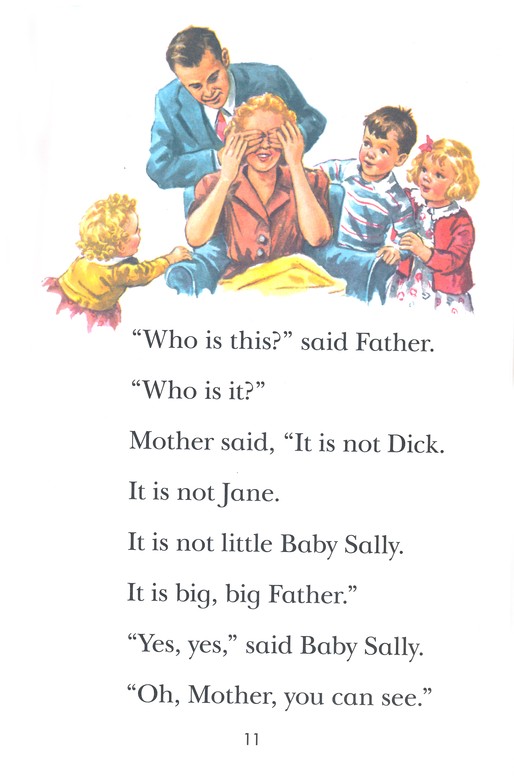
By 1930, the classic-oriented curriculum with a phonics foundation, had been purged in exchange for Fun With Dick and Jane, whole-word/look-see, early primary literacy, handicapping indoctrination. By the time of Rudolph Flesch’s “Why Johnny Can’t Read” 1955, no teachers had themselves been trained in classic literature, a prime goal of the atheist/agnostic/messianic secular-humanist founders of universal compulsory schooling from 1880-1920, the easier to ensure elite, top-down control of unruly lower masses in the interests of their tax-exempt non-profit foundation masters, the wealthy pathetic except for their inheritances who endowed the Carnegie, Ford and Rockefeller foundations.
Click ^ again to contract
September 23, 2022 – K–12: The Science of Illiteracy – By Bruce Deitrick Price
Emily Hanford became famous over the last several years for talking constantly about the Science of Reading. That’s where children learn to read in the simplest, most efficient way and go on to enjoy many hundreds of books. Long story short, what she means by the Science of Reading is phonics — nothing less, nothing else.
The problem is that the left in our country forced phonics into oblivion starting in 1931. So what was going on for those 90 years from 1931 to now? A titanic and quite stupid con, that’s what.
Basically, the professors of education at Harvard and such places identified and codified the things that work — and then (this is my summary) they made sure that none of those things are allowed in the schools. Only methods known not to work are praised in our classrooms. The simplest, most appropriate name for this approach is the Science of Illiteracy.
Sometimes the impression is given that these professors drifted around from one method to another. That’s actually not true. They have only one method — but it has many names (such as sight-words and Whole Word) — and they are content to hide inside the confusion they create.
Reading consists of learning two things: letters and sounds. If you’re not focusing on letters and sounds, you don’t have phonetic instruction of a phonetic language.
Note how precise the pseudo-reading program is. You get rid of letters and sounds. You don’t mention an alphabet, and you don’t teach children what the alphabet represents. The Science of Illiteracy is really easy. You just leave out the valuable parts and let kids struggle.
One of the oddest spectacles you’ll ever see is the top brains in American education all agreeing that the alphabet serves no useful purpose. How do you find fanatics like this?
These professors were monolithic; each one parroted the wisdom of the others. Each one finds a slightly different way of making the same dubious claims. Notice the smug, Olympian tone.
“Current practice in the teaching of reading does not require a knowledge of the letters,” says Dr. Donald D. Darrell.
“The skillful teacher will be reluctant to use any phonetic method with all children,” says Dr. Paul Witty.
Dr. Roma Gans tells it simply and starkly: “In recent years phonetic analysis of words at any level of the reading program fell into disrepute.”
“Little is gained by teaching the child sounds and letters as a first step to reading. More rapid results are generally obtained by the direct method of simply showing the word to the child and telling him what it is.” Thus spake Anderson and Dearborn.
“The words should be recognized as whole words. It is detrimental indeed to have the children spell or sound out the words at this stage.” That’s Bond and Wagner.
We have to thank Rudolf Flesch for creating a time capsule circa 1940 in the first chapter of his famous book Why Johnny Can’t Read. He quotes all the schemers shaping our culture. A dozen of these people took children down the wrong path so they would become victims of the Science of Illiteracy.
The success of Flesch’s book in 1955 was the first sign of resistance by ordinary citizens. The Education Establishment didn’t wait six months before it set up the counter-group known as the International Reading Association. This was a massive organization intended to keep teachers and parents in line. It succeeded to a tragic degree.
How do the professors refer to their voodoo reading? In the most respectful terms, as if Einstein had written it out for them. On the other hand, Rudolf Flesch complained that teaching children to read English with sight-words means eliminating 4,000 years of progress, as we moved from difficult symbol languages (such as Egyptian hieroglyphics) to more efficient ways to let great masses of people read their language.
Nineteen thirty-one was the beginning of the end of our school system. Yes, 1931. That’s when the education professors pushed phonics out of the public schools and imposed a sham method that virtually guaranteed that most students would become functional illiterates, evidently the goal of the Science of Illiteracy.
This power-grab in 1931 was historically remarkable. The Depression had just started. The country was nervous and unstable. The professors thought they had enough leverage to pull off a coup, almost as ambitious as the attack on Pearl Harbor but with even greater ramifications for the future.
I wouldn’t be surprised if all these professors quoted by Flesch were members of the Communist Party (AKA the Communist International). They were clearly in control of K–12 education in America. All they had to do was befuddle and outwit the public.
Money was a big factor. All the top professors made millions by creating a series of little books often referred to as Dick and Jane basal readers.
Please remember that Dr. Samuel Orton did a famous study in 1928 that determined that sight-words would mess up a child’s brain. Education professors had to pretend for decades that they believed in a method that they knew was fake. Their deception ushered in the Science of Illiteracy.
Throughout this saga, the Education Establishment bullied recklessly as they announced their visions, denounced all research that didn’t support their chicanery, and forced the children and parents to accept their Science of Illiteracy.
We see this reckless swagger now in the way the Democrats try to control government the same way they control education. Americans can learn so much about weaknesses in our democracy by studying K–12. Our ideals break down quickly when ruthless people break all the rules.
We can easily save the public schools, but only if we adhere to the Science of Reading. Here’s a four-minute version of that.
“Critical Literacy” as a kind of DEI of Language Arts — “How Modern Schools Make Terrible Writers (Deliberately)”
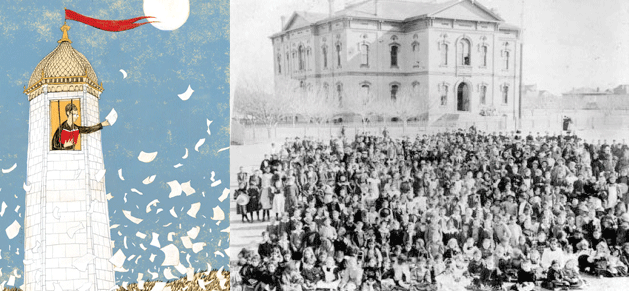
Psychology Prof. Edward Lee Thorndyke, at Columbia Teachers’ College, discouraged basic education which serves as a foundation for self-determination, as useless, to be preferred to mass socialization to train young people to be good employees and not to cause any trouble.
“Studies of the capacities and interests of young children indicate the advisability of placing little emphasis before the age of six upon either the acquisition of those intellectual resources known as the formal tools—reading, spelling, arithmetic, writing, etc.—or upon abstract intellectual analysis. Despite rapid progress in the right direction, the program of the average elementary school is too narrow and academic in character. Traditionally the elementary school has been primarily devoted to teaching the fundamental subjects, the three R’s, and closely related disciplines.”
Children are not taught their coherent knowledge-base–identifiable in the Trivium as “Grammar”–beyond the limited needs of the severely-constricted, lifetime employment target irrevocably established in their testing-record early in K-3. (Your child has a secret identity number available to all employers, so forget about evading the system.) The constant down-grade in education attainment, which kids could evade if they weren’t institutionalized, is not accidental or incidental, it is the dedicated purpose of schooling.
.
The Carnegie Foundation for World Peace and the Rockefeller Foundation funded pensions for “professional”, Normal School trained teachers at the turn of the 19th century…but at a price–if teachers wanted to avoid DDD and instead use initiative and good curricula to help students self-actualize, they would be got rid of.
.
That damned Cat in the Hat took nine months until I was satisfied. I did it for a textbook house and they sent me a word list. That was due to the Dewey revolt in the Twenties in which they threw out phonic reading and went to word recognition, as if you’re reading Chinese pictographs instead of blending sounds of different letters. I think killing phonics was one of the greatest causes of illiteracy in the country. Anyway, they had it all worked out that a healthy child at the age of four can learn so many words in a week and that’s all. So there were two hundred and twenty-three words to use in this book. – Theodor Geisel (Dr. Seuss), Arizona Magazine, June 1981Dr. Seuss was recruited from advertising with a list of 223 words for children to visually memorize without phonic deciphering ability, explicitly on the model of Chinese ideograms which must be “read” as pictures; late in life Theodor Geisel, now a race criminal, expressed regret at the damage he had caused facilitating dyslexia through whole-word/look-see, early primary, anti-literacy conditioning. Students’ usual comment when they are confronted with a new word is “I can’t read that, I’ve never seen it before”.
.
They have no chance of discovering marvelous decoding power of unfamiliar words, of the phonetic base literacy, from the ancient Chaldean/Phoenician phonemic-symbolic, sound-symbol alphabet which underlies Hebrew, Greek, Latin, German, Cyrillic/Russian and most western alphabet systems, one of the greatest innovations in human intellectual history.
.
Mr. Gatto noted that the military tested recruits in WW2 at mid-90 percentile literacy rates, low-80 in Korea, high-60 percentile in Viet Nam, now the military has difficulty getting volunteers who can read a basic newspaper article.
.
WE breed water dogs not to bite game birds, we hood falcons to control them, when race horses run too fast we “handicap” them with lead weights, and when students are in danger of independent learning so that they threaten to evade being conditioned into mindless consumers and docile employees of giant corporations, we subject them to “schooling”.
Mr. Gatto notes how the structure of schooling is designed to handicap children: timed bells, location controls, switching from 1 disconnected subject to another while not allowing project completion or drawing higher associations between subject areas, continual invasion of privacy and lack of personal time (extended by t.v. prior to the internet on cell-phones with the result that kids are cynical, cruel and disconnected from communities), teacher domineering of the students’ attention agenda, explicit deprivation of self-directed studies and adulthood-oriented learning activities, arbitrary judgment and punishment-reward system for making students dependent on teachers for WHAT to think, not HOW TO LEARN to think for one’s self on the Trivium model.
.
Students are taught to fear and envy the upper elites and despise the lower “dumb kids”. Students are age-segregated into ghettos of kids of similar age from whom they can’t receive any assistance discovering their own identities, which they used to get from adopting their parents’ livelihoods and culture as little adults. Disposable networks of limited purpose and duration fostered by schooling malfeasance have pushed out our formerly deep-rooted community involvement; school disrupts the free relationships in which people of all ages used to be able to freely associate with each other in in-depth personal involvement, people of different age categories offering involvement based on their life experience, young people giving the elderly their vigor, elderly people their wisdom and attention. Television pushed this out, now cell-phone based internet, in the future, field-generated connectivity to captivate all the senses so contact with ordinary reality can be continually monitored, regulated and modified by central controllers.
.
Childhood which Mr. Gatto declared from the pre-technolocratic past normally to be over by 7, or 11 at the latest, is being indefinitely extended beyond the 20s with “life long learning” conditioning. (I worked with a man who had been in college from just after high school until his mid-50s, who had taken 5 college degrees without attaining any noticeable life accomplishment, college was simply an unreal world in which there was no accountability or self-checking about the results of one’s activity, if there had been some harm to others caused by intellectual experiments upon real-life people, there was no accountability.)
.
From the beginning of the Prussian system as devised by behaviorsts like Pavlov’s teacher Wilhelm Wundt, students were socially conditioned to themselves insist on conformity in outlook and ideation, to be their own enforcers of ideological homogeneity, to socially punish rebellious individuality. This conformity drive continues with subtle but quite real, hierarchical student social groupings, Mean Girls (Queen Bees and Wannabes) under the personality corrosion of social media experience designed by experts in fostering addiction.
.
As noted by Paolo Lioni (Leipzig Connection), the Prussian behaviorist system which sees humanity as only an aggregate of conditioned animal reactions, was spread by late 19th century psychology dept. chairmen. Pre-adolescent schooling in the Prussian model largely comprised, in effect, extended kindergarten, until age 13, when the students were formally set to fighting one another. In the Prussian model, one in 200 students, the high-elite Alphas in Aldous Huxley’s Brave New World, were taught to regulate the lower orders through a control hierarchy reposing on a second layer, a sub-elite of 6 in 200 students destined to become Beta administrators. Students by 2nd grade have a confidential federal identifier number indelibly setting their lifelong employment fate, universally accessible through data sharing by corporations, but unknown to parents.
.
John Klyczek (School World Order: The Technocratic Globalization of Corporatized Education), a community college adjunct professor, takes this system, now using portable Chromebooks to convey operant conditioning long established in student computer software, into the period 1960-2021, with much background from Charlotte Thomson Iserbyt (The Deliberate Dumbing Down of America).
.
Chromebooks are used as the vehicle for the conditioning methodology of B.F. Skinner, only to give students the bare minimum of training destining them for narrow job categories with severely limited upward mobility potential which they are assigned from early K-12. The cookie-cutter system is designed to produce legions of mindless consumers and compliant employees in gigantic corporations.
Francie and Neely’s German Grandmother remarks on the potential of self-education to free young people from the rigidity of old-world class systems, in A Tree Grows in Brooklyn.
.
Mr. Gatto challenged B.F. Skinner’s method of “operant conditioning” treating human beings as lab rats. “I began to devise guerrilla exercises to allow as many of the kids I taught as possible the raw material people have always used to educate themselves: privacy, choice, freedom from surveillance, and as broad a range of situations and human associations as my limited power and resources could manage … to maneuver them into positions where they would have a chance to be their own teachers and to make themselves the major text of their own education.”
.
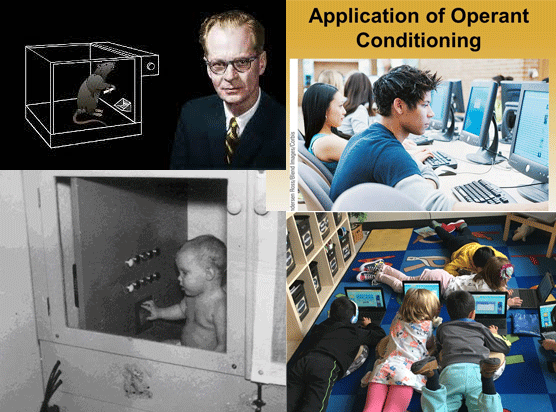
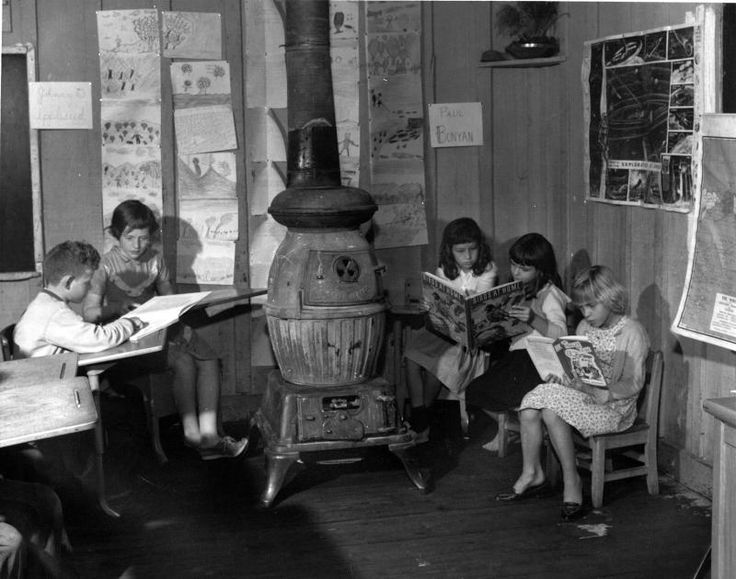
Mr. Gatto notes how a vast economic system irrevocably committed to the current schooling tyranny has an unreleasable deathlock on our children’s future. The arbitrary, capricious schooling policies come down from a vertical pipeline with such ingrained anonymity that school administrators have not the slightest idea from where they originate. A gamut of school unions dedicated to every occupational classification down to aides, crowd out the ostensible, original function of “education”; unions were originally part of the centralized master planning from the turn of the 19th century–compulsory dumbed-down schooling was founded on unions. They constantly diminish the interests of teachers as ever increasing numbers of non-instructional classified personnel, who exercise no direct educational function for students’ benefit, are continually hired, padding school-district employment rolls so that the expense per student continually rises with continually diminishing educational effectiveness, each new hire contributing union dues with no bargaining or interest advantage to the teachers who actually manage children, resulting in continually diminishing compensation. Union bosses comprise the top layer of an elite unable to be overthrown that relegates virtually all children to soul-prison from K-12 and beyond.
.
Mr. Gatto calls schooling the largest public works project in history, the largest business in America and probably in the world. Textbook companies, testing companies, schooling paraphernalia and school-lunch suppliers–to diminish the autonomy of families and make the isolated individual dependent on government–university educational-psychology departments and the federal government, a gobsmacking breadth of interlocking economic and political interest-sectors, together constitute an immovable, self-interested institutional block to improving the prospects for children.
.
The corporate consumerist and human resources management stakes in schooling have the effect that if children were ever to be taught self-reliance, autonomy and free thinking–public schools and colleges are far more rigidly doctrinaire than parochial-religious schools–if young people were ever to attain independence from the constant requirement of being taught what to think and minute oversight of what they do at all times, in schooling and employment, there would be a terrible crash in the existing, dependency-based economy.
.
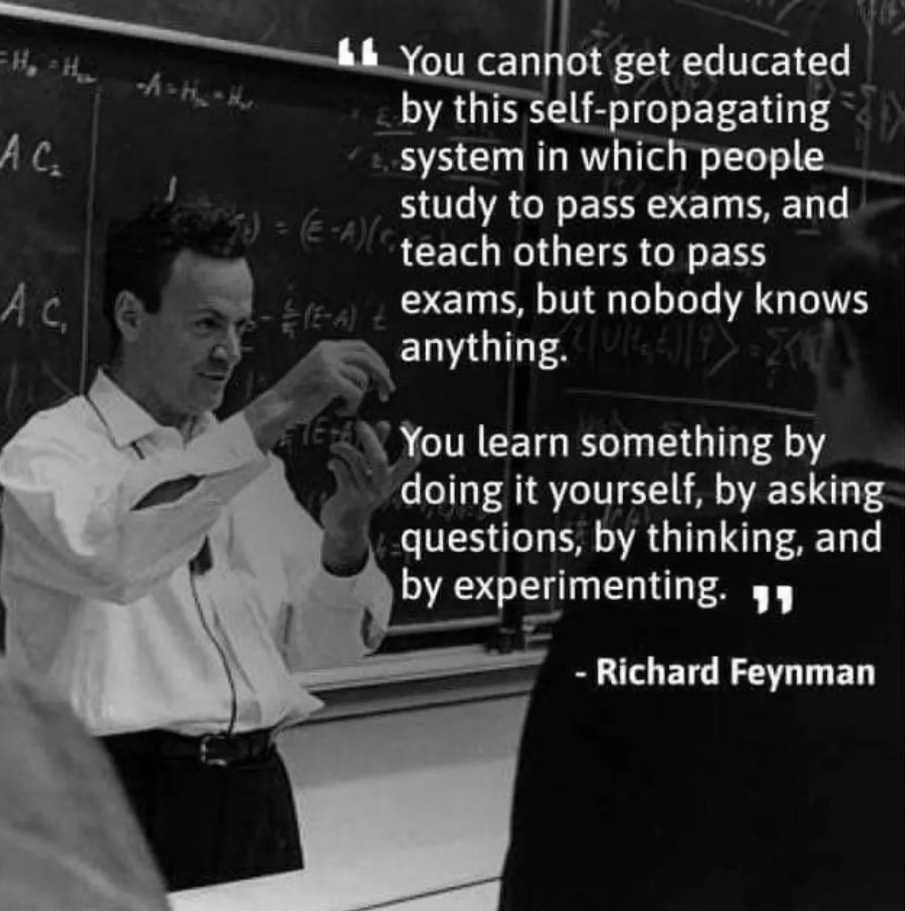
.
Charlotte Thomson Iserbyt asserts that if your children are undergoing standardized testing (“only good for projecting how students will perform on subsequent standard tests, not how they will adapt to real-life challenges” – Mr. Gatto), whether in public, private, charter schools or even home-schools, they are under the system’s control. The only escape would be to go off the grid, something that is largely impossible under a worldwide control hierarchy that has turned away from enforcing its mandates through conflict to finessing its dictates in the most subtle social control system in human history, by fostering addictive divertissments to keep perpetual children of all ages constantly distracted, the calculated addiction-fostering of the social-media interface now seamlessly integrated with Skinnerian operant conditioning for lifelong cognitive tyranny, delivered with “wrap-around”/”pipeline services” in The Community School.
Charlotte Thomson Iserbyt’s Belgian husband, Jan, remarked to her, that in Europe, beyond the reach of Madison Ave. opinion engineering, these types of observations aren’t relegated to wearers of tinfoil hats, they are open, common knowledge. “Oh, of course! We were taught all about this in school.” You are in trouble with the authorities merely for reading this article.
.

Author List
- Rudolph Flesch (Why Johnny Can’t Read and What You Can Do About It, free PDF), noting how whole-word/look-say reading pedagogy undermines the educational wellbeing of K-3 grade students.
- Samuel Blumenfeld (Crimes of the Educators, free PDF), noting how whole-word/look-say is associated with the vast expansion of dyslexia.
- John Taylor Gatto (Underground History of American Education, free PDF), a 30-year teaching veteran highly accomplished at evading, in his students’ interest, university teaching department-dictated, systematic anti-intellectual conditioning; he got to the root of a plan of immensely extensive time duration, from Plato to Baruch Spinoza to the present, under a high-level scheme to undermine the wellbeing of workers’ children in the interests of the late 19th century Titans of Wall St.
- Paolo Lioni (The Leipzig Connection, free PDF), details the connection between 19th century German behavioral psychology and the institutional establishment of American schooling 1880-1920.
- Charlotte Thomson Iserbyt (The Deliberate Dumbing Down of America, free PDF), a descendant of Yale Skull & Bones men, delved into the federal consolidation of rigid curriculum controls 1950-2020.
- Rita Kramer, Ed School Follies: The Miseducation of America’s Teachers. Rita couldn’t really crack the secretive world of educational psychology, but she had good, commonsense insights into what was wrong with the system, as seen from the perspective of teachers.
- continued now, in ongoing research, by John Klyczek (School World Order: The Technocratic Globalization of Corporatized Education).
Along with lightweight DDD (deliberate dumbing down) raves by Bruce Deitrick Price, there is additional corroboration from Georgetown professor Carroll Quigley, the author of the extremely candid Tragedy and Hope–he didn’t necessarily disagree with the covert methods of the master controllers, he just wanted to publicize them–, Antony Sutton (whistleblower on Wall St. support for the Bolshevik Revolution and the Chinese Communist Long March, ejected from Stanford’s Hoover Institution, died alone, penniless, his notes thrown out), and continued by serious studies of the current world order by Patrick Wood (Technocracy Rising: The Trojan Horse Of Global Transformation).