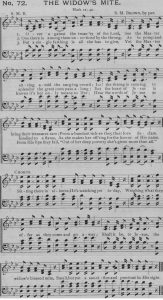
| 1) Over against the treas’ry of the Lord, See the Master sitting a- mid the surging crowd; Lo! the throng is coming, to bring their treasures rare; From abundant riches they their love declare. Chorus |
Chorus Sitting there in silence He’s watching yet today. Weighing what they offer as they come and go away; Shall it be to Jesus, the widow’s blessed mite, small but yet a sacrifice and precious in His sight. |
| 2) One there is among them, un- noticed in the throng; As in pomp and splendor, the great ones pass along; But the heart of Jesus, is kindled to a flame; As she makes her off’ring for the honor of His name. Chorus |
3) But a single farthing, is all she has to give, yet the Master knows it’s her only means to live; hear the words of Jesus, as from His lips they fall, “Out of her deep poverty she’s given more than all.” Chorus |
Question: A query of the virtue categorized under Fortitude, Magnificence, seems in ordinary language to be weighted to those with wealth, as if the virtue may more easily be acquired by persons of means.
An apocryphal story involving Saint “Mother” Teresa of Kolkata (Calcutta). It is supposed to have happened, that Mother Theresa took a bag of rice to a desperately poor woman. The recipient could hardly contain herself enough to show minimal hospitality to Mother Theresa, when she divided the rice in half and took half to her even poorer neighbor, who was of a different religion, as the primary recipient was Hindu, while her friend to whom she took half the rice was Muslim.
Is it that the strength of the woman’s virtue was diminished by her poverty?
The informal teaching about the anecdote is that the poor are the most generous.
Please resolve this question.
Reply from A.I.
No. For St. Thomas Aquinas, the poor woman’s poverty would not diminish her possession of the virtue of magnificence merely because she lacks the wealth needed for its large external acts. In fact, Aquinas addresses almost exactly your objection.
In Summa Theologiae II-II, q.134, a.3, objection 4 asks:
“Only the rich are capable of great expenditure. But the poor are able to possess all the virtues…”
Aquinas answers by distinguishing the virtue possessed inwardly from the external opportunity to exercise it on an objectively large scale:
“The chief act of virtue is the inward choice, and a virtue may have this without outward fortune: so that even a poor man may be magnificent.”
He then adds that a poor person may perform something magnificent relative to his circumstances, because “little and great are relative terms.” New Advent
That is remarkably close to your rice example.
The poor woman’s half-bag of rice
Suppose the story exactly as you give it. A desperately poor Hindu woman receives one bag of rice and immediately gives half to an even poorer Muslim neighbor.
The absolute monetary value is tiny. But the greatness of the undertaking relative to the giver’s means is enormous. She is surrendering half of something she herself urgently needs.
Aquinas therefore gives us two ways of understanding what is happening:
First, liberality. This is the virtue governing the ordinary good use of possessions—particularly giving and spending without being controlled by an excessive attachment to money or possessions. New Advent The woman’s act is an exceptionally powerful example of liberality/generosity.
Second, magnificence. Strictly speaking, Aquinas reserves magnificence for undertaking a great external work requiring proportionately great expenditure. A poor woman ordinarily cannot build a cathedral, endow a hospital, or finance some comparably great work. But Aquinas explicitly says that this does not mean she lacks the virtue. She can possess the habit of magnificence without possessing its material instruments. And he allows that something small absolutely can nevertheless be done magnificently in proportion to its kind and circumstances. New Advent
There is an additional passage attributed to Aquinas in the Supplement that states the principle with extraordinary clarity: a poor person can possess “the habit of magnificence, but not the act,” when the necessary great wealth is absent. New Advent
So wealth gives opportunity, not greater virtue
This resolves the apparent unfairness in the category.
A rich man may have more material with which to perform the characteristic external act of magnificence. That does not mean he possesses more virtue.
Indeed, a millionaire’s expenditure of $10,000 may reveal considerably less detachment from possessions than a destitute woman’s giving away half her food.
Your informal proposition—
“The poor are the most generous.”
—isn’t a universal proposition in Thomistic ethics; poverty does not automatically produce generosity. But the underlying insight is entirely compatible with Aquinas: the moral greatness of generosity is not measured simply by the dollar value of the gift.
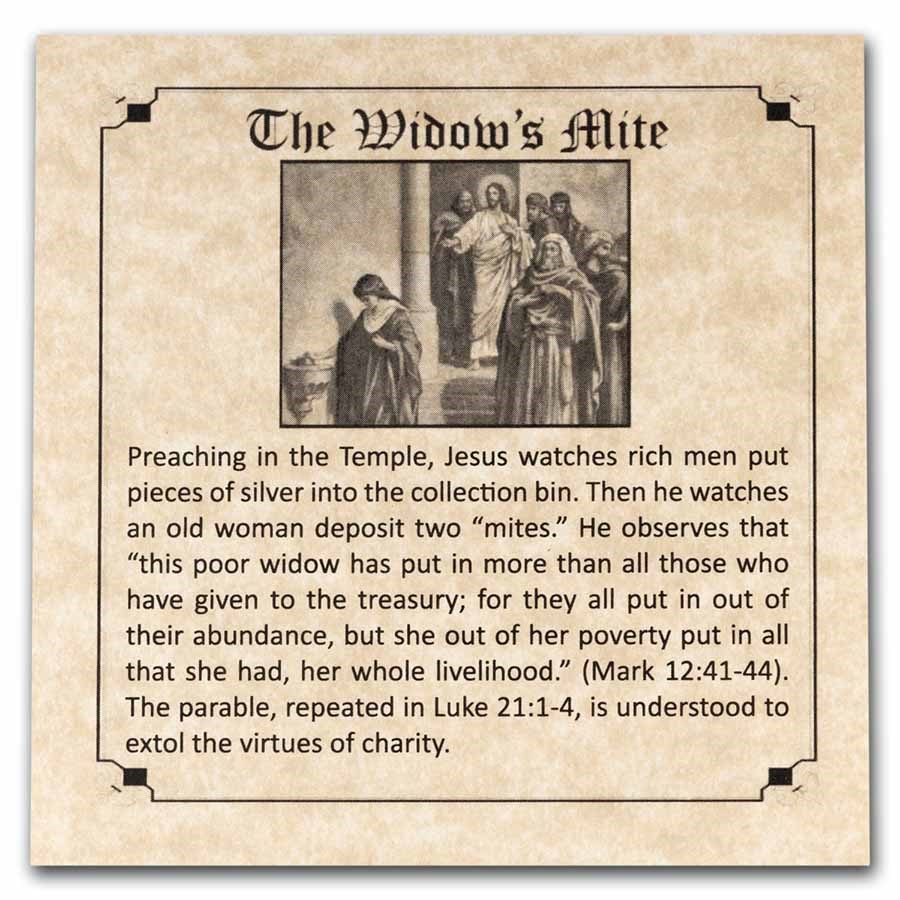
And of course that principle has an even more direct Gospel precedent: the widow’s mite (Mark 12:41–44). The wealthy gave larger amounts, yet Christ judged the widow’s tiny contribution greater because she gave from her poverty.
So I would resolve your proposed pun about “doubting Thomas” this way: on this particular difficulty, you don’t actually need to doubt Thomas. He noticed the apparent wealth bias himself, stated the objection explicitly, and answered that the poor can possess magnificence fully even when poverty prevents its normally large external manifestation.
Question: What are other resources from St. Thomas Aquinas which reflect on the meaning of “The Widow’s Mite”, “The Rich Man Who Went Away Sad when Told To Sell All He Had and Follow Jesus”, and “How Easily Can a Rich Man Enter Heaven? A Camel May Pass Through the Eye of a Needle More Easily.”
Reply
Yes. Aquinas treats all three Gospel passages within a fairly unified theology of wealth, detachment, liberality, voluntary poverty, and perfection of charity. For your continuing question about the poor woman’s rice, several passages are particularly useful.
1. The Widow’s Mite — Mark 12:41–44 / Luke 21:1–4
The closest systematic Thomistic resource is ST II-II, q.117, on Liberality. Aquinas explicitly says:
“Liberality depends not on the quantity given, but on the heart of the giver.”
That is almost the principle of the widow’s mite stated philosophically. The external amount is not the measure of the virtue; the giver’s rightly ordered attachment to possessions is. Aquinas also says that the liberal person characteristically gives readily, but must give according to right reason. New Advent
This is particularly important for your earlier Mother Teresa example. The widow and the poor rice-giver can manifest extraordinary liberality precisely through something whose absolute monetary value is small.
A second relevant text is ST II-II, q.134, on Magnificence. Here Aquinas distinguishes ordinary liberality from magnificence: magnificence concerns expenditure upon a great work. Thus the widow’s mite is most straightforwardly an instance of liberality, although, as we discussed, poverty does not prevent someone from possessing the virtue of magnificence. New Advent
2. The Rich Young Man — Matthew 19:16–22
For this passage Aquinas becomes remarkably explicit in ST II-II, q.186, a.3: “Whether poverty is required for religious perfection?”
He quotes Augustine’s interpretation of the young man’s sorrow: it is one thing never to possess something and another actually to surrender what one already possesses. Possession tends to produce attachment. Aquinas’s larger conclusion is that voluntary poverty removes an impediment to the perfection of charity. New Advent
Also see ST II-II, q.189, where Aquinas discusses the young man’s claim that he had kept the commandments. He quotes Jerome’s striking argument: if the young man had perfectly fulfilled “love thy neighbor as thyself,” why did he become sorrowful when Christ told him to sell his possessions and give them to the poor? New Advent
This also explains something easily missed in Matthew 19. Aquinas does not treat:
“Sell what thou hast, and give to the poor”
as an ordinary command requiring every Christian to become propertyless. It is an evangelical counsel of perfection. In ST I-II, q.108, he distinguishes commandments from counsels and places voluntary poverty among the counsels. New Advent
3. “It is easier for a camel…” — Matthew 19:23–26
A particularly useful treatment occurs in ST II-II, q.188, a.7. Aquinas identifies three dangers associated with riches:
- care and anxiety over possessions;
- love or attachment to riches, which possession can intensify;
- vainglory or self-exaltation arising from wealth.
He explicitly quotes Jerome on the camel passage: Christ says that entering heaven is difficult, not simply that possession of riches makes salvation impossible. New Advent
This matters because Aquinas emphatically does not teach:
rich = vicious; poor = virtuous.
Abraham was wealthy and nevertheless perfect. Aquinas expressly invokes Abraham when explaining that great wealth and great spiritual perfection can coexist. New Advent
The problem is attachment, not the mere existence of property.
4. One passage especially pertinent to your original question
I would add ST III, q.7, a.2, concerning Christ’s virtues. Aquinas makes a surprising connection between poverty, liberality and magnificence. Liberality and magnificence are praiseworthy because a person does not value wealth so highly that he refuses to relinquish it for something that ought to be done. Christ’s complete detachment from riches therefore manifested these virtues in the highest manner, despite His poverty. New Advent
That is strong evidence against interpreting magnificence as a virtue whose possession somehow favors the wealthy.
The three Gospel stories together
They produce a coherent Thomistic progression:
| Gospel passage | Thomistic lesson |
|---|---|
| Widow’s mite | The virtue of giving is not measured by the quantity given. |
| Rich young man | Possessions can create an attachment that obstructs greater perfection. |
| Camel and needle | Riches create serious spiritual difficulties, but wealth does not make salvation impossible. |
| “With God all things are possible” | Salvation ultimately depends upon God’s grace, not economic status. |
And there is an illuminating counterweight from Augustine which Aquinas’s tradition inherits. Preaching on the camel and needle, Augustine turns immediately to the poor and warns them not to boast of poverty: a humble and devout rich person can surpass a proud or vicious poor person. New Advent
So your earlier proposition—“the poor are the most generous”—contains a Gospel insight but needs that qualification. The widow’s poverty made the magnitude of her sacrifice extraordinary; it did not make her virtuous automatically. Conversely, wealth gives a person much greater material scope for magnificence, but does not give him the virtue. In Aquinas’s scheme, what matters morally is the person’s ordered or disordered relation to wealth, ultimately governed by charity. New Advent
For the particular line of inquiry you’ve been developing, I would read ST II-II qq. 117 (Liberality), 118–119 (Avarice and Prodigality), 134 (Magnificence), 186 a.3 (Voluntary Poverty), and 188 a.7 (Riches and Perfection). Together they provide a much fuller Thomistic treatment than any one of the three Gospel passages considered by itself.
Query
Expand on James 2:1-6
1 My brethren, have not the faith of our Lord Jesus Christ of glory with respect of persons.
2 For if there shall come into your assembly a man having a golden ring, in fine apparel, and there shall come in also a poor man in mean attire,
3 And you have respect to him that is clothed with the fine apparel, and shall say to him: Sit thou here well; but say to the poor man: Stand thou there, or sit under my footstool:
4 Do you not judge within yourselves, and are become judges of unjust thoughts?
5 Hearken, my dearest brethren: hath not God chosen the poor in this world, rich in faith, and heirs of the kingdom which God hath promised to them that love him?
6 But you have dishonoured the poor man. Do not the rich oppress you by might? and do not they draw you before the judgment seats?
Reply
James 2:1–6 fits your preceding inquiry about wealth, poverty, virtue, and Aquinas unusually well. St. James goes beyond saying that poverty does not diminish virtue. He warns Christians that wealth itself can cause them to misjudge another person’s moral worth.
“Respect of persons”
The governing idea in verse 1 is acceptio personarum—respect of persons or partiality. Aquinas discusses this directly in Summa Theologiae II-II, q.63.
For Aquinas, it is not wrong to make distinctions among persons when the distinction is relevant to the matter at hand. Giving a more competent person an office because of competence is just. The injustice occurs when one gives someone preference because of a characteristic irrelevant to what is due—wealth, family connection, social standing, and so forth.
That makes James’s example almost a textbook case. Two Christians enter the assembly. One has a gold ring and splendid clothing; the other is poorly dressed. The congregation knows nothing about their virtue. Yet it converts visible wealth into a judgment of personal worth.
Aquinas actually cites James 2:2 in his treatment of respect of persons. He explains that honor may properly be given because of someone’s excellence, but not merely because riches happen to make the person socially impressive. Aquinas, Summa Theologiae II-II, q.63
“Judges of unjust thoughts”
Verse 4 gets to the interior moral error:
“Do you not judge within yourselves, and are become judges of unjust thoughts?”
The injustice begins before anybody is deprived of money or physically injured.
The rich man’s appearance prompts an internal valuation:
gold ring + fine clothing → this man deserves honor
while:
poverty + mean clothing → this man may be relegated beneath my footstool.
That connects strongly with your earlier question about magnificence. If wealth gives a person greater opportunity for conspicuous external works, James warns us not to infer from that visibility that the wealthy person therefore possesses greater virtue.
“God chosen the poor … rich in faith”
Verse 5 does not mean that every poor person is virtuous or that every rich person lacks faith. James himself qualifies the expression:
“the poor in this world, rich in faith”
The paradox is deliberate:
poor according to the world’s measure; rich according to God’s.
This closely resembles Christ’s judgment concerning the widow’s mite. The observers could see that wealthy people deposited objectively larger sums. Christ instead disclosed a morally relevant fact invisible to them: the widow had given “all she had.”
That gives us three different measurements:
| Measure | What appears “great” |
|---|---|
| Social judgment | the man with the gold ring |
| Monetary measurement | the large gift of the wealthy |
| Moral/divine judgment | faith, charity, sacrifice, rightly ordered will |
This is precisely why your poor woman dividing her rice is such a useful example. Poverty can conceal rather than diminish the magnitude of virtue.
But James goes further in verse 6
“But you have dishonoured the poor man.”
The congregation has effectively reproduced inside the Christian assembly the hierarchy of prestige operating outside it.
Then James introduces a biting irony:
“Do not the rich oppress you by might? and do not they draw you before the judgment seats?”
He is not establishing the proposition “rich people are evil.” He is exposing the irrationality of servility toward wealth: you are importing worldly prestige into the Church to honor precisely the social class whose power can be used against you.
The traditional commentator Cornelius a Lapide reads the passage in this direction: James condemns honoring riches as riches and despising poverty, rather than legitimate honor attached to genuine dignity, office, age, virtue, etc. Cornelius a Lapide, commentary on James 2
The connection with Aquinas’s magnificence
This produces an important distinction for the question you’ve been pursuing.
Aquinas can simultaneously say:
(1) Magnificence ordinarily requires considerable resources for its characteristic external act.
and:
(2) The poor person can possess the virtue of magnificence.
James supplies a powerful Scriptural warning against confusing those two things.
The wealthy benefactor who finances a church can perform an externally magnificent work. The destitute widow cannot finance one. But you cannot therefore rank their souls by their expenditures. Indeed, Christ’s widow demonstrates that the apparently insignificant gift can disclose an extraordinary interior disposition.
That also sharpens the Mother Teresa rice anecdote. Giving half one’s food when one has almost nothing may manifest a degree of liberality, charity and detachment that a vastly larger donation by a wealthy person does not necessarily demonstrate.
So I would put James 2 beside the widow’s mite as the Scriptural corrective to the apparent wealth-bias you detected in the word magnificence:
Material wealth enlarges what a person is able to spend. It does not enlarge the person’s virtue.
James’s stronger warning is that we are ourselves committing an injustice when we allow the first fact to persuade us of the second.
Question: Integrate with the value of poor people performing Works of Mercy, Spiritual and Corporal with James 2:15–17
15 And if a brother or sister be naked, and want daily food:
16 And one of you say to them: Go in peace, be ye warmed and filled; yet give them not those things that are necessary for the body, what shall it profit?
17 Even so faith, if it have not works, is dead in itself.
Reply
James 2:15–17 substantially strengthens the point from James 2:1–6. The first passage says do not mistake wealth for human worth; the second says Christian faith must become concrete charity. Taken together with the traditional Corporal and Spiritual Works of Mercy, this gives poor Christians a particularly important place: poverty can restrict the material scale of one’s works without restricting one’s capacity for mercy or holiness.
James deliberately chooses bodily necessities
His examples are strikingly elementary:
a brother or sister is naked and lacks daily food.
Those correspond directly to what Catholic tradition calls the Corporal Works of Mercy:
- Feed the hungry
- Give drink to the thirsty
- Clothe the naked
- Shelter the homeless
- Visit the sick
- Visit the imprisoned
- Bury the dead
James’s criticism is that merely saying:
“Go in peace, be ye warmed and filled”
while doing nothing within one’s power for the person’s bodily need makes the profession of faith sterile.
This closely parallels 1 John 3:17: someone possessing this world’s goods who sees his brother in need but closes his compassion against him cannot plausibly claim that God’s charity abides in him.
But James does not make mercy the privilege of the wealthy
This becomes especially important when James 2:15–17 is read together with James 2:1–6.
The rich Christian plainly possesses greater material capacity to feed and clothe others. Consequently, he bears responsibilities proportionate to those resources. But it would reverse James’s teaching to conclude:
greater financial capacity = greater capacity for Christian virtue.
The poor person may have very little to give and yet perform works of mercy continually.
The traditional distinction between Corporal and Spiritual Works of Mercy makes this particularly clear:
| Corporal mercy | Spiritual mercy |
|---|---|
| Feed the hungry | Instruct the ignorant |
| Give drink to the thirsty | Counsel the doubtful |
| Clothe the naked | Admonish the sinner |
| Shelter the homeless | Comfort the sorrowful |
| Visit the sick | Forgive injuries |
| Visit the imprisoned | Bear wrongs patiently |
| Bury the dead | Pray for the living and the dead |
Most of the Spiritual Works of Mercy require no wealth whatsoever. Neither do several Corporal Works necessarily require substantial property. A poor person can visit someone who is sick or imprisoned, care for a dying neighbor, help bury the dead, share labor, prepare another person’s food, or give from the little he possesses.
The widow’s mite supplies the missing measure
Christ’s widow gives us the principle by which such acts should be evaluated.
A rich man might feed a hundred people while sacrificing comparatively little. A poor woman might feed one hungry neighbor by surrendering half of her own dinner.
The first act is materially greater. The second can involve greater personal sacrifice and charity.
That is why the rice story you introduced fits these passages so naturally. Assuming the story as told, the woman does exactly what James demands. She could quite truthfully say:
I myself need this food.
Nevertheless, she encounters another person who needs it still more and converts her concern into an actual work: she divides the rice.
Her poverty therefore doesn’t reduce the moral significance of her work. It supplies part of the circumstance by which its extraordinary generosity becomes intelligible.
Aquinas supplies an important qualification
Aquinas would nevertheless prevent us from adopting the maxim “the poor are the most generous” as though poverty itself were a virtue.
Neither wealth nor poverty determines charity.
A wealthy person can possess extraordinary charity; a poor person can be avaricious. Conversely, someone can have very little property while possessing tremendous liberality, because liberality concerns the person’s rightly ordered disposition toward external goods—not simply the number of dollars transferred.
This produces a useful distinction:
The material magnitude of a Work of Mercy depends partly upon what one possesses. The moral magnitude depends upon charity, right intention, circumstances, sacrifice, and what one reasonably can do.
That principle also prevents James 2:17—“faith without works is dead”—from being misunderstood as though the rich had some inherent advantage in producing “works.”
The Spiritual Works of Mercy make that especially evident
Consider an elderly poor woman without enough money to make charitable donations. During a week she might:
comfort a grieving neighbor; forgive someone who injured her; patiently endure another person’s faults; counsel someone in distress; teach a child his prayers; pray for the living and the dead; and visit another poor person who is sick.
Measured financially, she has given almost nothing.
Measured according to the traditional Works of Mercy, her life may be crowded with works.
That helps integrate the two halves of James 2:
James 2:1–6: Do not honor the rich and dishonor the poor because you have confused material appearance with personal worth.
James 2:15–17: Do not reduce Christianity to sympathetic words. Love must actually do something for the person in need.
The Works of Mercy: “Doing something” encompasses both bodily and spiritual charity, much of which is available to Christians regardless of wealth.
The widow’s mite: God judges giving in relation to the giver, not merely by its external quantity.
There is consequently a rather beautiful reversal within James 2. The poor person in verses 2–6 initially appears as the recipient whom Christians are tempted to dishonor. But nothing in verses 15–17 confines that person to being a recipient. The poor Christian is also an agent of mercy.
And that is perhaps the strongest connection with your original question about magnificence. A person without money need not occupy a spiritually passive position while wealthy people perform all the important works. The poor possess the same vocation to active charity; their circumstances change the material available to charity, not charity’s capacity to make their actions genuinely great.