Return to the Main Page, Initial Description ⧉
The main page, of which this is a supplement, is a mockup for a video of The Chaplet of the Divine Mercy currently under development. The video’s elements are in three layers.
The images with captions constitute a front layer. The images were originally developed as slides; in some instances there is excessive “white-space” at the bottom of the images. Please scan past the white-space and continue praying.
For the middle layer, praying out-loud the prayers displayed on the images, which you can do while scanning through each image in a series while each section’s background music is playing, is part of a testing process to eventually set up narration tempo (how fast the prayers are read), to be incorporated in the final video.
The back layer is the music audio tracks. Their length will be carefully balanced with the tempo of the narration; some notes may have to be cut or added to coordinate with the prayer sections. (In Windows, the music can be halted by touching the spacebar.)
You can help develop this project by praying the prayers and commenting the experience.
All seven of the background music selections are historic masterworks of the common practice period (1450-1950) based upon the text of the Gregorian Plainchant hymn “Ave Verum Corpus”, Hail True Body.
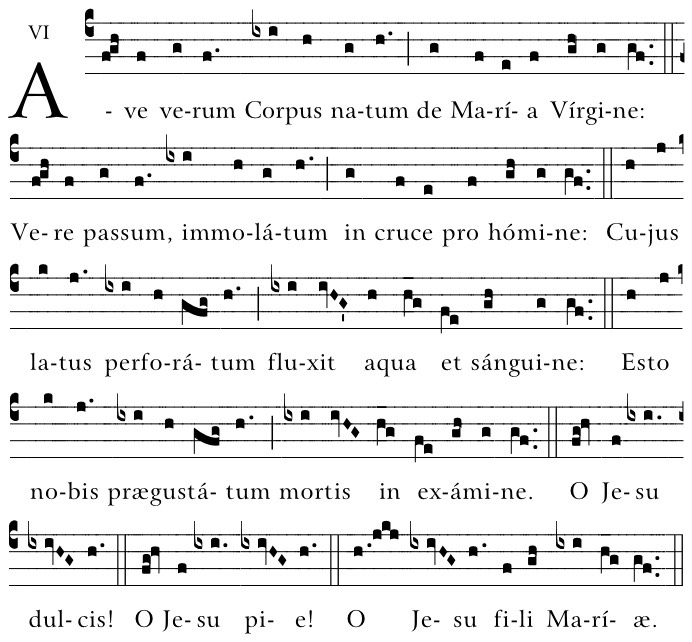
To audition the core thematic hymn, click the ▶ button to listen to the Gregorian Plainchant monody Ave Verum Corpus, attributed to Pope Innocent VI (1282-1362), or play the music in a New Window ⧉
|
Ave verum corpus, natum
de Maria Virgine, vere passum, immolatum in cruce pro homine cuius latus perforatum fluxit aqua et sanguine: esto nobis praegustatum in mortis examine. [O Iesu dulcis, O Iesu pie,
O Iesu, fili Mariae. Miserere mei. Amen] |
Hail, true Body, born
of the Virgin Mary, having truly suffered, sacrificed on the cross for mankind, from whose pierced side water and blood flowed: Be for us a sweet foretaste in the trial of death! [O sweet Jesus, O holy Jesus,
O Jesus, son of Mary, have mercy on me. Amen.] |
All Recordings (Omnibus)
Introduction (Josquin)
First Decade (Byrd)
Second Decade (Charpentier)
Third Decade (Philips)
Fourth Decade (Albinoni)
Fifth Decade (Gregorian Polyphony)
Conclusion (Elgar)
Return to the Main Page, Introduction ⧉
To audition background music for the Introductory Prayers of The Chaplet of the Divine Mercy (the short Introductory declarations of The Chaplet of the Divine Mercy, The Pater Noster, The Ave Maria, and The Apostles Creed), click the ▶ button to listen to an organ setting of the composition Ave Verum Corpus by the middle Renaissance Burgundian composer Josquin des Prez (1455-1521), or play the music in a New Window ⧉
Introduction (Josquin)
Return to the Main Page, the First Decade of prayers of The Chaplet of the Divine Mercy ⧉
To audition background music for the First Decade of prayers of The Chaplet of the Divine Mercy, click the ▶ button to listen to an organ setting of the polyphonic acapella composition Ave Verum Corpus by the high Renaissance English composer William Byrd (1540-1623), or play the music in a New Window ⧉
First Decade (Byrd)
Return to the Main Page, the Second Decade of prayers of The Chaplet of the Divine Mercy ⧉
To audition background music for the Second Decade of prayers of The Chaplet of the Divine Mercy, click the ▶ button to listen to an organ setting of a composition of Ave Verum Corpus by the early French Baroque composer Marc-Antoine Charpentier (1643-1704), or play the music in a New Window ⧉
Return to the Main Page, the Third Decade of prayers of The Chaplet of the Divine Mercy ⧉
To audition background music for the Third Decade of prayers of The Chaplet of the Divine Mercy, click the ▶ button to listen to an organ setting of a composition of Ave Verum Corpus by the late Renaissance and early Baroque English composer Fr. Peter Philips (1560-1628), or play the music in a New Window ⧉
Return to the Main Page, the Fourth Decade of prayers of The Chaplet of the Divine Mercy ⧉
To audition background music for the Fourth Decade of prayers of The Chaplet of the Divine Mercy, click the ▶ button to listen to a setting of a composition of Ave Verum Corpus as adapted from a fragment of figured bass, traditionally called an Adagio, attributed to the 18th-century Venetian Baroque composer Tomaso Albinoni (1671-1751), by the twentieth century Italian musicologist and composer Remo Giazotto (1910-1998), or play the music in a New Window ⧉
Justification for the choice of this music to accompany Ave Verum Corpus, which would be surprising to most informed classical listeners, is taken from a children’s choral group recording of Ave Verum Corpus applied to the Giazotto/Albinoni piece.
(The video is embedded below, but if it doesn’t load, it may be evoked in a new window at https://www.youtube.com/watch?v=CprYUY9RQ_0 ⧉.)
Return to the Main Page, the Fifth Decade of prayers of The Chaplet of the Divine Mercy ⧉
To audition background music for the Fifth Decade of prayers of The Chaplet of the Divine Mercy, click the ▶ button to listen to a polyphonic organ setting, implicitly in a minor mode, of the Gregorian Plainchant Ave Verum Corpus, the original attributed to Pope Innocent VI (1282-1362), or play the music in a New Window ⧉
Return to the Main Page, the Ending Prayers of The Chaplet of the Divine Mercy ⧉
To audition background music for the Ending Prayers of The Chaplet of the Divine Mercy, click the ▶ button to listen to an organ setting of the composition Ave Verum Corpus by the late Romantic English composer Edward Elgar (1857-1954), or play the music in a New Window ⧉
Return to the Main Page, `The Chaplet of the Divine Mercy Prayers, Music & Images` ⧉
How do the several main Traditional Catholic groups, the SSPX, the FSSP and ICKSP regard the orthodoxy of The Chaplet of the Divine Mercy?
There is variation among Traditional Catholic groups, and it hinges on both their general approach to private revelation and their attitude toward the post–Vatican II liturgical landscape.
1. SSPX (Society of St. Pius X)
-
Official stance: The SSPX has historically been critical of the Divine Mercy devotion and chaplet. Their critique is not just about liturgical novelty, but also about the theological underpinnings of St. Faustina Kowalska’s diary.
-
Concerns include:
-
Ambiguous language about God’s mercy (they argue it risks minimizing God’s justice).
-
The association with John Paul II, who canonized Faustina and promoted the devotion, which the SSPX often interprets in the broader context of post-conciliar innovations.
-
The earlier 1959 prohibition (the Holy Office initially forbade public propagation of the devotion due to translation and theological concerns; this ban was lifted in 1978). The SSPX tends to point back to the fact that serious doubts once existed at the Vatican level.
-
-
Summary: The SSPX does not promote the Chaplet of Divine Mercy and often warns the faithful against it, preferring traditional devotions such as the Rosary, Sacred Heart, and traditional Stations of the Cross.
2. FSSP (Priestly Fraternity of St. Peter)
-
Official stance: The FSSP, being in full canonical union with Rome and generally deferential to papal guidance, accepts the Chaplet of Divine Mercy as orthodox and legitimate.
-
Practice: Many FSSP parishes may not emphasize it as much as the Rosary or traditional devotions, but they do not oppose it. Individual priests sometimes lead Divine Mercy devotions, especially around Divine Mercy Sunday.
-
Summary: Seen as an approved, orthodox devotion, but not at the center of their apostolate.
3. ICKSP (Institute of Christ the King Sovereign Priest)
-
Official stance: Like the FSSP, the ICKSP is fully regularized under Rome and does not oppose the Chaplet of Divine Mercy.
-
Practice: Their spirituality is heavily oriented to the Sacred Heart, Christ the King, and liturgical solemnity, so the Chaplet of Divine Mercy is not a major emphasis. However, it is not excluded or regarded as heterodox.
-
Summary: Accepted as orthodox, but not as central as older, “classic” devotions.
Overall picture
-
SSPX: Skeptical, critical, discourages it.
-
FSSP & ICKSP: Accept its orthodoxy, do not oppose it, but usually emphasize older traditional devotions.
Return to the Main Page, `The Chaplet of the Divine Mercy Prayers, Music & Images` ⧉
Click ^ again to contract
Please wait for video content to load, below.
https://youtube.com/watch?v=pPWG-gb61X4&si=sEdUWU2JWo6kpalC