
Text commentaries on
“Stella Maris (Star of the Sea)”
Return to Main ↑, “Mary Immaculate, Star of the Morning”
Click ^ again to contract
Fr. Paul Kramer gives secondary evidence for the narrative of the 3rd Secret of Fatima suppressed by Cardinal Sodano, but derived from Cardinal Bea, Cardinal Stritch and St. Pio of Pietralcina, who had first-hand knowledge of that, the Narrative of the 3rd Secret by the BVM. Contrary to assertions that there had been a gradual, superficial “conversion” to Christianity in Russia, by an Orthodox Church which was continually a department of the Soviet State, the total consecration of Russia to the Immaculate Heart of Mary by the Pope in union on the same day with each Bishop of the world in their home cathedrals, is expected to result in the instantaneous, total conversion of Russia as a nation, to effect the complete conversion of the world. (The interview avers to an alleged occasion in 1957 during which Pope Pius XII is supposed to have read the Third Secret, declined to publish it because Our Lady said it was not to be publicized until 1960, and that on that occasion, Chicago’s Samuel Cardinal Stritch discussed what he could about that reading with his assistant, Fr. Lawrence Emmett Hughes.)
TCE 46: Fr. Paul Kramer and Fatima – Padre Peregrino
Return to Main ↑, “O Purest of Creatures – Sweet Star of the Sea”
Click ^ again to contract
My soul has exulted before God, my Saviour. (Luke 1:47) Exult again and again, Mary, because you give to the world the joy of its salvation.
Rejoice, O Immaculate Mother, because you preserve the honor of virginity.
Exult with happiness, virgin made mother, because you preserve the honor of virginity, from the maledictions which weigh upon women.
You can surely rejoice before God. Him whom the earth and heaven united, could not contain, you have within you.
You warm Him in your arms, you place Him joyfully in His crib, you alone, Mother, can adore Jesus, your Son, born of you in time, He who, before you, before all time, possesses God as Father from all eternity.
You alone fulfill the duties of a mother to the God who confers maternity on you. You alone can truly exult in Him who renders you sublime and heavenly.
Let heaven and earth praise you, Mary, let every creature reecho your praises! Let my whole being rejoice in your presence, let my soul exalt you, beloved mother! The tongue is powerless to speak of your grandeurs, and the spirit to conceive the wonder of you. Thus, I can only bow before you humbly and say to you prayerfully: receive me in your arms, O my Mother, listen with love to the sighs of my heart, and receive with me all who are mine.
My soul is breathless at the sight of Jesus, since it knows that in Him alone is found its happiness.
Show me this mysterious treasure which you keep hidden within you, Mary!
Yes, I believe that He is the only-begotten Son of the Father, and I also believe that He is your first-born, mysteriously born of your virginity.
I know that He is my God, my Saviour, and my Father, and I know that He chose you for His mother. Oh! I wish through you to see Him, your Son, and I wish to adore Him in your arms. O Mother, you have clothed Him in your flesh. Hence He can not be seen without your aid. And if you do not deign to show Him to us, who will ever merit to look upon Him? Through you alone we have access to the Son, and through the Son we shall reach the Father.
Therefore, show me Jesus: He satisfies my soul. I do not seek nor desire a Father other than Jesus, your Son, my Saviour and my God.
O Mother, I have longed with such desire to see Jesus whom you love more than all others! My soul sighs and longs to contemplate Him, my heart rejoices and seeks to possess Him!
(If you wish with Mary to see Jesus, you must, first of all, have pure eyes. If you wish with Mary to see Jesus, you must, secondly, be holy and pious. If you wish with Mary to see Jesus, you must, finally, abandon the earth and strive to rise, little by little, to heaven.)
Prayer: O Mary, I know my sins and my failings. I know that I am unworthy to see Jesus. But I am unable to rest until I have contemplated Him.
Neither can I forbear to plead, for I know He wishes to be asked. My heart urges me to insist, for I know that you, too, wish that we ask. Thus, O my Mother, I desire to persevere in prayer and contemplation.
– Thomas a Kempis – The Imitation of Mary – Chapter XIII – “The Exultations of Mary” – (Sermons on the Nativity, Sermon II)
Return to Main ↑, “Mother of Our Lord and Saviour”
Click ^ again to contract
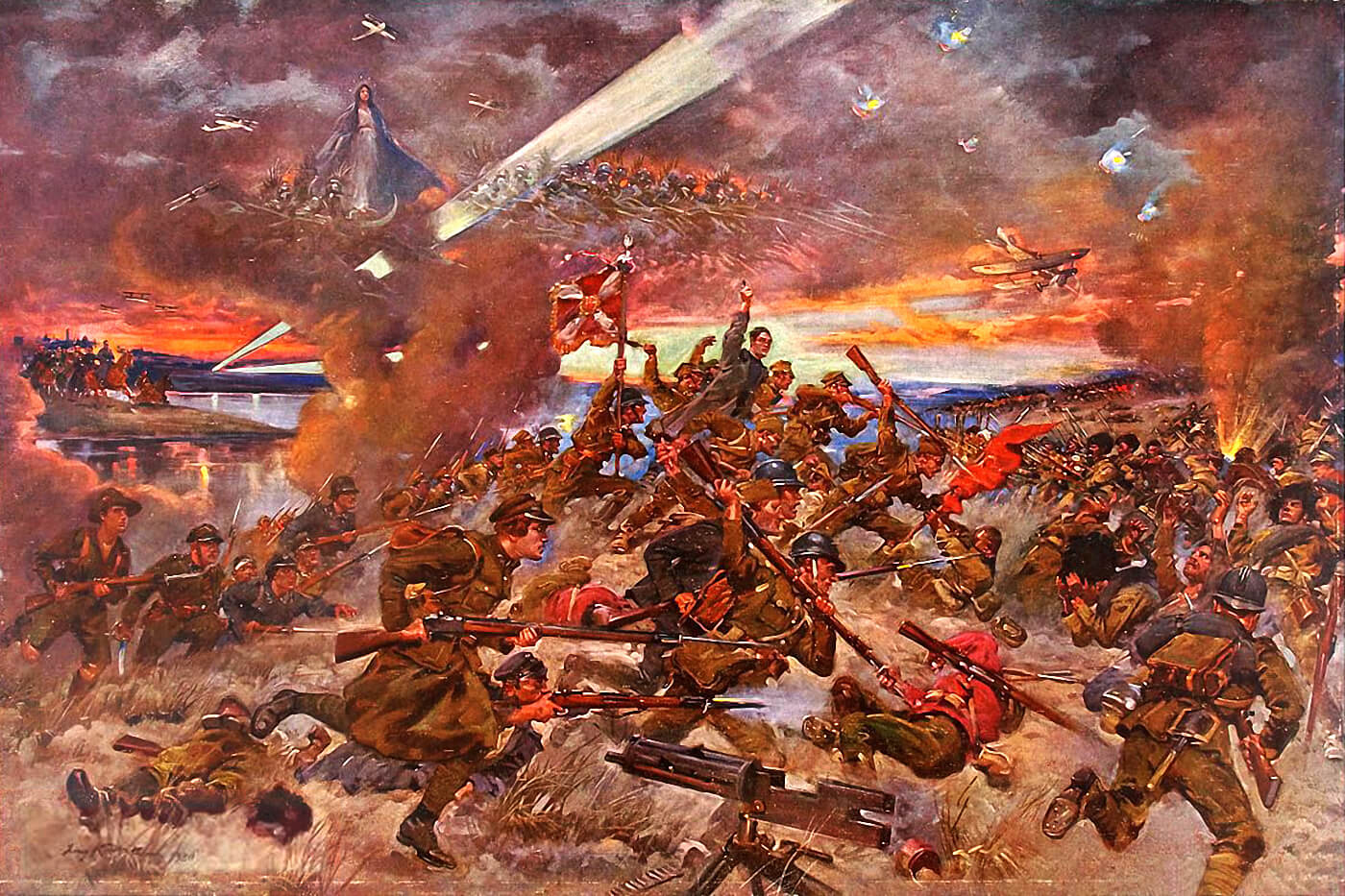
III – The Miracle on the Vistula
In the 1920, Bolshvik invasion of Poland, after national prayers at Jasna Góra, when our Lady appeared to the retreating Russians–but the Poles couldn’t see her because she was behind them–the Bolsheviks failed to defeat the Polish army but the Masonic government of Poland didn’t want our Lady to receive credit.
Without our Lady’s intervention, the Bolsheviks would have swept through Poland to waiting Communist cadres all through Germany, France and the rest of Continental Europe, easily overthrowing those governments, the most complete international rout since the French Revolution. Modern history would have been completely different, to an extent unimaginable to us–without the Miracle on the Vistula, by our Lady of Jasna Góra.
Return to Main ↑, “O Sanctissima”
Click ^ again to contract
Return to Main ↑, “Assumpta Maria Est”
Click ^ again to contract
Chapter XXX – OF THE ETERNAL ROYALTY OF LOVE
I. Upon her head, like that of a Queen, is placed a crown of twelve stars. These twelve stars on the brow of Mary are the twelve prerogatives of the Queen and of the Mother before God in heaven.
She possesses, indeed, in the Church Triumphant, surpassing all other blessed spirits, four special prerogatives:
- the power of listening with great goodness,
- of condescending with great mercy,
- of intervening for us with great power,
- and of succoring on earth with great ease.
She, has besides, in the Church Triumphant, four privileges, outstanding among all:
- she is resplendent more than all others;
- she is glorified more than all others;
- she is loved more tenderly than all others;
- she is honored more fervently than all others.
Mary possesses also, in relation to the Trinity, four particular favors, which are for her like brilliant stars midst fainter stars.Better, truly, than those who contemplate the glory of the Divine Trinity,
- she contemplates fully the Divine Trinity Itself:
- she knows with greater joy its sweetness,
- she comprehends with greater profundity its mysteries,
- she tastes with greater charm its richness.
II. Listen again, listen devoutly, to what the greatest of the servants of Mary, the doctor of gentle speech, St. Bernard, said to his Religious about the stars which form a crown on the forehead of the Virgin:
No one can estimate the importance of the jewels, no one can count the number of the gems which adorn the diadem of Mary in Heaven.
It is an undertaking above our power, that of examining the value, or of scrutinizing the composition of her brilliant aureole.We shall undertake to do so with humility.Without wishing to penetrate the secrets of the Lord, it seems that one can see in the twelve stars the twelve prerogatives of our Mother.We find indeed in the Virgin Mary,
- privileges granted to her soul,
- privileges infused into her heart,
- privileges attached to her body.
And if we multiply this number three,by the number of the four known favors,we shall find the number of twelve stars which shine on the brow of Mary, our Queen.We find these wonders,
- at her birth,
- in the salutation she received from the angel,
- in the overshadowing of her by the Holy Spirit,
- and finally in the conception of Jesus Himself .
The holy doctor goes on to enumerate the circumstances of the life of our Mother in which grace brought its favors.
III.
Let us meditate therefore, often and with piety, on the life and deeds of Mary. Let us chant hymns and canticles in her honor, on the days of her solemnities.
Come before her altar and before her image, incline your head, kneel before her, as if you were seeing Mary herself present before you.
Raise your eyes and contemplate Mary speaking with the angels, or better still, Mary holding on her knees her son Jesus:
In contemplating the Mother of Mercy, say then, with a burst of confident love:
IV. Prayer:
O most loving Virgin Mary, Mother of God Queen of Heaven, Mistress of the Earth,
O you, the Joy of Saints, and the Salvation of sinners, listen to the appeals of our repentant hearts!Listen to the desires of our souls at prayer!
Come to the help of the poor and the infirm!
Renew the courage of the afflicted!
Protect your children against their enemies!
Deliver them from the snares of the devils.
Lead them near to you in blessedness in heaven, where you reign with your Son in the midst of the elect for all eternity!
(Cloistral Discipline, Chap. XIV)
HOMILY – ROYALTY OF HEART
I. Everything is sold or bought on the earth: power, favor, gold, conscience itself. Only the heart is not sold; it gives itself or does not give itself, fashioned as it is with a spark of royalty.
A great orator has said: the heart is the whole of man, it is the raison d’etre of a woman.
The heart of Mary is the greatest of hearts, after the Heart of Jesus.
Was not the Heart of Jesus fashioned from a bit of the human heart of Mary?
II. The Heart of Jesus, united to the divinity in the person of Christ, has transmitted by its contact with the heart of His Mother something of Its grandeur and beauty to the heart of Mary.
Mary is therefore queen by her heart, as she is queen by her human destiny.
Her heart vibrates with more force than the heart of any other creature.
It is less sublime than the Heart of God, but it is unique in heaven and earth.
III. Oh! how sweet it is to feel yourself near this heart which has loved with a mother’s love an Infant God, and which loves with the same maternal love all the children of men.
MEDITATION – THE PERPETUITY OF LOVE
Love is not a simple sentiment; it is a gigantic force: women hold a power which they do not know.
Only Mary has known what power the heart of a mother has.
To know how to love, and to love always, is an ardent life, an active life, a very short life.
Not to love is to be dead.
Love addresses itself to the spirited person who vibrates and not to the lifeless or inactive person.
Love supposes beauty, and sometimes creates it or exalts it.Let us love Mary!
She has beauty,
she has grace,
she has charm.
No creature equals her; no woman surpasses her.
She comes next after God, as Dante sings.
Let us say to her then with the heavenly poet:
O Mother, O Queen, O Mary, help us to love you, help us to praise you.
You are beauty, la belta, and we cannot admire you enough.
You are goodness, la bonta, and we cannot praise you enough.
We say to you therefore the only word worthy of you, the word sent from heaven, the word of the Archangel:
Ave Maria!
Practice: Imitate the early Christians and often recite the Liturgical Office of the Holy Virgin.
Thought: O Mary, bless us and our families.
Nos cum prole pia, benedicat Virgo Maria.
Return to Main ↑, “Mother, Dear, O Pray for Me”
Click ^ again to contract
Call upon the Blessed Virgin to Cover you with her mantle of Humility
…He hath regarded the humility of Hs handmaid… – The Magnificat
A priest gave the advice that, upon being tempted against chastity, we may say three Ave Marias, a remedy without fail. We may also ask for the Blessed Virgin to cover us with her mantle of humility, when we discern that we are afflicted with pride.
From The Glories of Mary by Saint Alphonsus LiguoriMary,” says Richard of St. Laurence, “protects us under the mantle of humility.” O my queen, I can never be really thy child unless I am humble; but dost thou not see that my sins, after having rendered me ungrateful to my Lord, have also made me proud? O my Mother, do thou supply a remedy. By the merit of thy humility obtain that I may be truly humble, and thus become thy child, Amen.
“Humility,” says St. Bernard, “is the foundation and guardian of virtues;” and with reason, for without it no other virtue can exist in a soul. Should she possess all virtues, all will depart when humility is gone. But, on the other hand, as St. Francis de Sales wrote to St. Jane Frances de Chantal, “God so loves humility, that whenever He sees it, He is immediately drawn thither.”
This beautiful and so necessary virtue was unknown in the world; but the Son of God Himself came on earth to teach it by His Own example, and willed that in that virtue in particular we should endeavor to imitate Him: “Learn of Me, because I am meek and humble of heart.” Mary, being the first and most perfect disciple of Jesus Christ in the practice of all virtues, was the first also in that of humility, and by it merited to be exalted above all creatures. It was revealed to St. Matilda that the first virtue in which the Blessed Mother particularly exercised herself, from her very childhood, was that of humility.
The first effect of humility of heart is a lowly opinion of ourselves: “Mary had always so humble an opinion of herself, that, as it was revealed to the same St. Matilda, although she saw herself enriched with greater graces than all other creatures, she never preferred herself to anyone.”
The Abbot Rupert, explaining the passage of the sacred Canticles, “Thou hast wounded my heart, my sister, my spouse, …with one hair of thy neck“, [Cant. 4:9] says, that the humble opinion which Mary had of herself was precisely that hair of the Spouse’s neck with which she wounded the heart of God.
Not indeed that Mary considered herself a sinner: for humility is truth, as St. Teresa remarks: and Mary knew that she had never offended God: nor was it that she did not acknowledge that she had received greater graces from God than all other creatures; for an humble heart always acknowledges the special favors of the Lord, to humble herself the more: but the Divine Mother, by the greater light wherewith she knew the infinite greatness and goodness of God, also knew her own nothingness, and therefore, more than all others, humbled herself, saying with the sacred Spouse: “Do not consider that I am brown, because the sun hath altered my color.” [Cant. 1:5]
That is, as St. Bernard explains it, “When I approach Him, I find myself black.” Yes, says St. Bernardine, for “the Blessed Virgin had always the majesty of God, and her own nothingness, present to her mind.” As a beggar, when clothed with a rich garment, which has been bestowed upon her, does not pride herself on it in the presence of the giver, but is rather humbled, being reminded thereby of her own poverty; so also the more Mary saw herself enriched, the more did she humble herself, remembering that all was God’s gift; whence she herself told St. Elizabeth of Hungary, that “she might rest assured that she looked upon herself as most vile and unworthy of God’s grace.”
“Therefore”, St. Bernardine says, that “after the Son of God, no creature in the world was so exalted as Mary, because no creature in the world ever humbled itself so much as she did.” Moreover, it is an act of humility to conceal heavenly gifts.
Mary wished to conceal from St. Joseph the great favor whereby she had become the Mother of God, although it seemed necessary to make it known to him, if only to remove from the mind of her poor spouse any suspicions as to her virtue, which he might have entertained on seeing her pregnant: or at least the perplexity in which it indeed threw him: for St. Joseph, on the one hand unwilling to doubt Mary’s chastity, and on the other ignorant of the mystery, “was minded to put her away privately“.[Matt. 1:19]
This he would have done, had not the Angel revealed to him that his Spouse was pregnant by the operation of the Holy Ghost.
Again, a soul that is truly humble refuses her own praise; and should praises be bestowed on her, she refers them all to God. Behold, Mary is disturbed at hearing herself praised by St. Gabriel; and when St. Elizabeth said, “Blessed art thou among women … and whence is this to me, that the Mother of my Lord should come to me? … blessed art thou that hast believed,” [Luke 1:42]
Mary referred all to God, and answered in that humble Canticle, “My soul doth magnify the Lord,” [Ibid.,46-47] as if she had said: Thou dost praise me, Elizabeth; but I praise the Lord, to Whom alone honor is due: thou wonderest that I should come to thee, and I wonder at the divine goodness in which alone my spirit exults: “and my spirit hath rejoiced in God my Saviour”. Thou praisest me because I have believed; I praise my God, because He hath been pleased to exalt my nothingness: “because He hath regarded the humility of His handmaid.”
Hence Mary said to St. Bridget: “I humbled myself so much, and thereby merited so great a grace, because I thought, and knew, that of myself I possessed nothing. For this same reason I did not desire to be praised; I only desired that praises should be given to the Creator and Giver of all.”
Wherefore an ancient author, speaking of the humility of Mary, says: “O truly blessed humility, which hath given God to men, opened Heaven, and delivered souls from Hell.
“It is also a part of humility to serve others. Mary did not refuse to go and serve Elizabeth for three months.
Hence St. Bernard says, “Elizabeth wondered that Mary should have come to visit her; but that which is still more admirable is, that she came not to be ministered to, but to minister.
“Those who are humble are retiring, and choose the last places; and therefore Mary, remarks St. Bernard, when her Son was preaching in a house, as it is related by St. Matthew, [12:46] wishing to speak to Him, would not of her own accord enter, but “remained outside, and did not avail herself of her maternal authority to interrupt Him.”
For the same reason also when she was with the Apostles awaiting the coming of the Holy Ghost, she took the lowest place, as St. Luke relates, “All these were persevering with one mind in prayer, with the women, and Mary, the Mother of Jesus.” [Acts 1:14]
Not that St. Luke was ignorant of the Divine Mother’s merits, on account of which he should have named her in the first place, but because she had taken the last place amongst the Apostles and women; and therefore he described them all, as an author remarks, in the order in which they were. Hence St. Bernard says, “Justly has the last become the first, who being the first of all became the last.
“In fine, those who are humble, love to be contemned; therefore, we do not read that Mary showed herself in Jerusalem on Palm Sunday, when her Son was received by the people with so much honor: but on the other hand, at the death of her Son she did not shrink from appearing on Calvary, through fear of the dishonor which would accrue to her when it was known that she was the Mother of Him Who was condemned to die an infamous death as a criminal.
Therefore she said to St. Bridget, “What is more humbling than to be called a fool, to be in want of all things, and to believe one’s self the most unworthy of all? Such, O daughter, was my humility; this was my joy; this was all my desire with which I thought how to please my Son alone.
“The Venerable Sister Paula of Foligno was given to understand, in an ecstasy, how great was the humility of our Blessed Lady; and giving an account of it to her confessor, she was so filled with astonishment at its greatness, that she could only exclaim, “O, the humility of the Blessed Virgin! O, Father, the humility of the Blessed Virgin, how great was the humility of the Blessed Virgin! In the world there is no such thing as humility, not even in its lowest degree, when you see the humility of Mary.”
On another occasion our Lord showed St. Bridget two ladies. The one was all pomp and vanity. “She,” He said, “is Pride; but the other one whom you see with her head bent down, courteous towards all, having God alone in her mind, and considering herself as no one, is Humility: her name is Mary.” Hereby God was pleased to make known to us that the humility of His Blessed Mother was such that she was humility itself.
There can be no doubt, as St. Gregory of Nyssa remarks, that of all virtues there is perhaps none the practice of which is more difficult to our nature, corrupted as it is by sin, than that of humility. But there is no escape; we can never be true children of Mary if we are not humble.
“If,” says St. Bernard, “you can not imitate the virginity of this humble Virgin, imitate her humility.” She detests the proud, and only invites the humble to come to her: “Whosoever is a little one, let him come to me.” Mary,” says Richard of St. Laurence, “protects us under the mantle of humility.”
The Mother of God herself explained to St. Bridget what her mantle was, saying, “Come, my daughter, and hide thyself under my mantle; this mantle is my humility.” She then added that the consideration of her humility was a good mantle with which we could warm ourselves; but that as a mantle only renders this service to those who wear it, not in thought but in deed, “so also would her humility be of no avail except to those who endeavored to imitate it.” She then concluded in these words: “Therefore, my daughter, clothe thyself with this humility.”
“O, how dear are humble souls to Mary,” says St. Bernard; “this Blessed Virgin recognizes and loves those who love her, and is near to all who call upon her; and especially to those whom she sees like unto herself in chastity and humility.” Hence the Saint exhorts all who love Mary to be humble: “Emulate this virtue of Mary, if thou lovest her.” Marinus, or Martin d’ Alberto, of the Society of Jesus, used to sweep the house, and collect the filth, through love for this Blessed Virgin.
The Divine Mother one day appeared to him, as Father Nieremberg relates in his life, and thanking him, as it were, said, “O, how pleasing to me is this humble action done—for my love.”Then, O my queen, I can never be really thy child unless I am humble; but dost thou not see that my sins, after having rendered me ungrateful to my Lord, have also made me proud? O my Mother, do thou supply a remedy. By the merit of thy humility obtain that I may be truly humble, and thus become thy child, Amen.